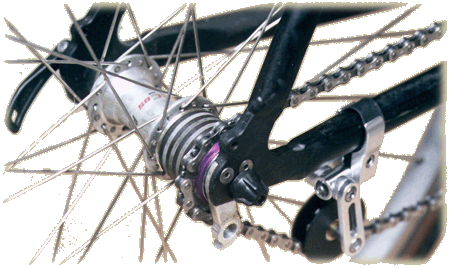
Most modern bicycles use cables to control the gear shifting and brakes. These cables, also known as "Bowden cables" consist of two parts, an inner cable of twisted or braided steel wire, and an outer cable housing. Cables transmit force by a combination of tension on the inner cable and compression to the housing.
In many installations the housing doesn't run along the full length of the cable, but transmits the compressive part of the load to the frame by means of housing stops, fittings with holes large enough for the cable, but too small for the housing to pass through. Some cable stops feature adjusting barrels. This site features an extensive Article on Cable Installation.
A cable guide is a fitting or frame feature which guides a piece of bare inner cable around a corner. Most multi-speed bicycles have cable guides to get the derailer cables past the bottom bracket.
Older derailer bikes used either brazed-on or clamp-on guides just above the bottom bracket, but newer bicycles have a guide under the bottom bracket.
The below-the-bottom-bracket option is cheaper, and, for some bicycles with very small chainweels, it eliminates interference betwixt the rear derailer cable and the bottom of the front derailer cage. It also makes cleaning the frame slightly easie.
The above-the-bottom-bracket system is superior in that the cable is shorter and the loop of housing at the rear derailer is not as tight, since the cable stop is atop the chainstay, rather than beneath it.
Poor lubrication of bottom-bracket cable guides is a common cause of autoshifting. Some bicycles use a cable guide on one side of the seat cluster for a rear cantilever-brake cable, rather than to use a short length of housing between two housing stops.
A fitting found at each end of a piece of cable housing. It consists of a socket to receive the housing, with a small hole at the bottom, which will let the inner cable slide through, but hold the housing end rigidly in place. Some cable quides are slotted, so the cable can be inserted and rmoved without threading it through.
The speed at which the pedals turn, measured in Revolutions Per Minute. Inexperienced cyclists tend to ride in higher gears than they should, pedaling at a slower cadence. When walking the legs swing like pendulums, at a natural rate. When pedaling, thelegs are more like connecitng rods attached to the crankshaft of an engine, and can spin much faster.
Most experienced cyclists pedal at cadences in the range of 70-90 RPM. This puts less strain on the joints, particularly the knees. Racing cyclists often use even higher cadences for bursts of acceleration.
retainersA metal or plastic holder for the bearing balls in a ball bearing. Use of a cage keeps the balls from bumping into one another, and allows the use of fewer balls. In the case of traditional cup-and-cone bearings used on bicycles, the primary purpose of caged balls is to save labor. More formally known as a retainer.
A holder for carrying a water bottle.
The part of a derailer through which the chain passes. The front derailer cage is a simple guide, the rear derailer cage contains the jockey pulley and the tension pulley.
The outer part of a conventional pedal, the part that comes into contact with the rider's shoe.
A caliper is a measuring device with moving parts that come together to determine the dimensions of a part.
Most bicycle brakes use a similar mechanism to move the brake shoes inward toward the rim, so they are called caliper brakes. A caliper brake uses a single assembly to move both brake shoes together, unlike a cantilever brake which has a separate unit on each side of the rim.
A brake caliper attaches to the bicycle by a single bolt, through the center of the forkcrown or the brake bridge on the seat stays.
A mechanical device for converting one kind of motion to another, usually rotary to linear. The main application for cams in bicycle technology is in quick-release mechanisms. As the quick-release lever is rotated from the open to the closed position, the cam built into the pivoting end of the handle applies a push to the quick-release mechanism housing, and a pull to the skewer.
The leading Italian maker of bicycle parts. The company's founder, Tullio Campagnolo, invented the quick release. The company was instrumental in the development of the derailer.
Campagnolo parts are so highly-regarded that Campagnolo's proprietary dimensions have, in several cases, become adopted as de facto international standards. This is particularly so in the case of headsets.
The Campagnolo headset dimensions are 26.4 mm for the forkcrownrace and 30.2mm for fitting the frame races into the head tube. Other common systems, such as J.I.S., use a larger diameter (such as 27 mm) for the steerer, and a smaller diameter (30 mm) for the head tube. These frame/fork dimensions can be easily machined to fit Campagnolo style headsets.
A cantilever brake has two separate arms, or cantilevers, one on each side of the rim. Each arm pivots on an independent boss attached to the frame or fork, and the two arms are usually coordinated and linked by a transverse (or straddle or crossover) cable that runs above the top of the tire. The transverse cable is commonly connected to the main brake cable by a yoke. In some newer designs, the end of the main cable becomes half of the transverse cable, and a short link wire forms the other half. For details on cantilevers, see my articles on Cantilever Adjustment and Cantilever Geometry.
A recent variation on cantilever brakes is the V brake, which dispenses with the transverse cable altogether. This was adopted for mountain bikes because the transverse cable could snag on a knobby tire if the main cable broke --often resulting in a serious crash.
Traditional cantilever brakes and V brakes have the pivots below the rim. The U brake and roller-cam brake, which have the pivots above the rim.
A frame style popular on cruisers, in which the curved seat stays pass by the seat cluster and continue on in a graceful arc to join the bottom of the head tube.
The "capacity" of a particular derailer model is the largest range of sprocket sizes it can handle:
For front derailers, when the derailer is mounted high enough to clear the largest chainwheel, there is a certain minimum size that you need for the smallest ring so that the chain won't be dragging over the bottom of the front cage. Different front derailers have different capacities depending on how tall their cages are. It is expressed in a number of teeth, which is the difference between the largest and smallest chainwheel. For instance, a 52/42/30 crank set would call for a front derailer with a minimum 22 tooth (52-30) capacity.
Front derailers are also designed to be used with a certain size for the largest chain ring. The curvature of the outer cage plate is matched to this size. If you use a different-sized big ring, capacity may be reduced. If the big ring is substantially larger than the derailer is designed for, shifting precision will suffer. If the big ring is much smaller than the derailer is designed for, it may shift OK, but you are likely to have to "trim" the front derailer as you shift the rear derailer to the extremes.
A front derailer for triple chainrings also may need to have an inner cage plate adapted to the size difference between the outer and middle chainrings. If this difference is more than a few teeth, the inner cage plate must be deep from top to bottom, so it can push the chain from small chainwheel to the middle one without overshifting it onto the large one. The cage plate also may have a special shape, intended to improve this shift.
For rear derailers, the capacity relates to the amount of chain slack the derailer can take up, and is equal to the front range (22 in the example above) plus the rear range. Thus, if you have a 52/42/30 crank set, and a 12-28 (16 tooth difference) cluster, the total capacity required would theoretically be 38 teeth (22 front difference + 16 rear difference).
Manufacturers specify this fairly conservatively. They must do so, because they have to assume that some of their derailers will be sold to incompetent cyclists, who will abuse their drive trains by using the smallest chainwheel with the smaller rear sprockets.
Competent riders can considerably exceed the official rated capacity, since they will not misuse the granny ring by running it with the smaller rear sprockets, so it doesn't matter if the chain hangs slack in those gears.
Rear derailers are also commonly designed for a particular maximum size of rear sprocket. If you exceed this size by too much, the jockey pulley may rub against the sprocket when using the lowest gear.
Derailers will also commonly work with larger sprockets than manufacturers' ratings suggest. For instance, Shimano's models designated as "road" derailers are generally listed for a "maximum" sprocket of 27 teeth...because 27 teeth is the largest size that bShimano makes in a designated "road" cassette. However, in almost all cases, these derailers, even the short-cage models, will handle rear sprockets as large as 30 teeth in practice. (This somewhat depends on the design of the frame's derailer hanger, so once in a while you will find a particular installation where you can't use a 30, but I've never seen one where a 28 wouldn't work.)
I'll also mention that many folks seem to be a bit mystified and intimidated by derailers. They're actually quite inexpensive and easy to replace, so it is foolish to allow the limitations of a particular derailer to keep you from having the gearing appropriate to your riding style/needs.
A threaded fastener designed to screw into metal, with a head that is expected to stick up above the surface. Cap screws are commonly used on bicycles to secure bottle cages, luggage racks and other accessories. Cap screws are also used in many other locations on bicycles, but the nomenclature "cap screw" is rarely if ever used by practical mechanics. Most people call these "bolts" in practice, though sticklers may contend that is not proper usage.
A Shimano trademark for a Freehub and cassette with unusually small, 9-10-11- tooth sprockets in the three top positions. The Capreo is intended for use with a small wheel that would require an unusually large chainwheel to get high gears with another cassette. The major parts of this hub (except for the 5 larger sprockets) are not compatible with those of other Shimano Freehubs and cassettes.
The rider of a tandem who is responsible for steering. This is usually the front rider. The captain is usually also responsible for controlling the gears and brakes. See also stoker.
Carbon filaments bonded together with a resin, in a technology similar to fibreglass. The resulting composite material is very strong in the direction that the fibers run in. Carbon fiber is available in the form of tubing with a woven/braided weave, which can be glued into lugs to build more-or-less conventional frames. A more sophisticated approach is to lay up the carbon fiber cloth in a specific shape, in a mould the shape of the finished bicycle. This allows the orientation of the fibers to provide strength in the direction of the actual stress. Carbon fiber technology shows great promise, but there have been reliability problems with many early models.
Bearings which are assembled in a modular unit, as opposed to cup-and-cone bearings, which may be disassembled down to the individual bearing balls for service.
Cartridge bearings are the only type of ball bearings used in most industrial products; bicycle technology is the major area where cup-and-cone bearings still survive, but they are in decline even in the bicycle industry. Cartridge bearings are pre-adjusted and generally easier to work with, but on the other hand, cup-and-cone bearings are tolerant of minor misalignment, such as may occur due to flexing of a hub axle or inaccurate machining of a bottom bracket.
An old-style cup-and-conebottom bracket. The lock ring wrench is about to loosen the lockring, the pin wrench is engaging two of the holes in the adjustable cup.
A cartridge bottom bracket. The splined tool is shown above the bottom bracket. The crank would need to be removed to actually use the tool.
A cluster of sprockets and spacers designed for use on a freehub. Some of the sprockets and spacers may be semi-permanently attached to one another by bolts or rivets. See my article on Shimano Cassettes
If you're speaking generically about multiple rear sprocket sets, or in other situations where you don't know which type is on a particular bike, the safest generic term is "cluster" which can apply equally to freewheels and cassettes.
Shimano internal-gear hubs with more than three speeds connect the shift cable to the hub by the use of a "cassette joint", which is a pulley mechanism that fits around the axle, just outboard of the sprocket (but inboard of the bicycle's frame. For details on this, see my Nexus Technical Page.
The forming of metal parts by pouring molten metal or other material into a mould. This is the cheapest way of making large quantities of parts that are of shapes that cannot be produced by stamping. The parts are not generally as strong as those that can be made by forging, and parts made in a re-usable mould cannot be of as complicated shape as is possible with CNC machining from billets, because some shapes cannot be removed from a mould without breaking it.
An exotic form of casting, called investment casting or "lost wax" casting permits casting of complicated shapes by using single-use plaster moulds that can be broken apart to free the cast part from the mould. This is an expensive process used mainly for high quality lugs and fork crowns.
In tadpole tricycles and other vehicles with two front wheels, the steering axis for each front wheel should be slanted so that it intersects the road surface somewhere in the middle of the tire track for that wheel. This is what is meant by "center-point steering." The benefit of this is that braking forces or forces caused by hitting bumps in the road have little or no tendency to cause the wheel to steer to the side.
A caliper brake in which the main cable runs down the centerline of the bicycle, using a yoke to connect to a transverse cable. Technically, a normal cantilever brake is a form of centerpull brake, but the term is normally used to refer to caliper brakes only. This type of brake was popular from the late 1960's to the early 1980's, but is currently out of fashion. Centerpull brakes are a good choice for bicycles that have a long reach from the mounting point to the rim.
In measuring distances between round things, whether they're tubes or holes, the usual method is to measure the distance from the centers of the circles.
In the case of measuring bicycle frames, all measurements are assumed to be center-to-center except for the seat tube length.
Seat tubes are sometimes measured from the center of the bottom bracket, but the upper end point may vary depending on the measurement system chosen. Center-to-center seat tube measurements measure to the intersection of the center of the top tube with the center of the seat tube.
This is the French spelling of "center". It used to puzzle me that British writers used the French spelling, despite the fact that the syllable "re" has a totally different sound than "er." However, as it turns out, most Britons don't pronounce the "r" in this word anyway, so for them it's a phonetic non-issue. In the U.S., where we do pronounce the "r", the spelling "center" makes more phonetic sense than the French "centre."
Ceramic-coated rims Some aluminum rims are coated with a ceramic material primarily to improve wet weather braking, and to reduce rim wear that often results when rim brakes are used in muddy/wet conditions.
The ceramic is fairly brittle, and if the rim gets dented even a little bit, the ceramic can flake off. If this happens, the braking will become very rough as the rim grabs/releases at the damaged section.
Modern bicycles use roller chain to connect the cranks to the rear wheel. Chain drives are among the most efficient means of power transmission known.
Chain size is specified by pitch and width. The pitch is the distance between rollers (1/2" on all modern bicycle chain). The width is nominally the width where the sprocket teeth fit in. Bicycle chain comes in four basic widths:
3/16" (.1875", 4.76 mm), used until the middle of the 20th century on many bicycles; this was inch-pitch chain.
1/8" (0.125", 3.18 mm) chain is used on most single-speed bicycles, and bicycles with internal gearing.
3/32" (0.094", 2.30 mm) chain is used on derailer equipped bicycles that have more than 3 cogs at the rear.
Even somewhat narrower chain, typically .090" or 2.29 mm between the inner plates, is used for derailer-equipped bicycles with 9 or more sprockets at the rear.
There is some confusion in these numbers because the actual width of a 1/8" sprocket is typically 1/8"(3.175 mm) and the gap between the inner side plates of the chain must be slightly wider to fit over the teeth. The width of the teeth on derailer-equipped bicycles with 5 or 6 rear sprockets was traditionally 2 mm, and the 3/32" (2.30 mm) chain would fit over those teeth -- but the smaller widths with larger number of sprockets are not as well standardized. Chains for derailer applications also come in various external widths. Newer clusters which have more sprockets also use chain with thinner side plates and with rivets whose ends are flush with the side plates.
For more information on chains, see my article on Chain Maintenance.
In some triple-chainring installations, typically when the "granny" gear is unusually small, it may be impossible to get good shifting to the "granny" chainring with the normal derailer adjustments.
A loose adjustment of the low-gear stop causes the chain to derail past the small chainring, but a tighter setting results in slow downshifting to the small ring.
In such cases, a good, if inelegant, solution is sometimes to install a chain deflector, an anti-derailment device that clamps to the seat tube. These products, such as the 3rd Eye Chain Watcher ® and the N-Gear Jump Stop ® set up a barrier preventing the chain from overshooting the small ring, no matter how loose the low-gear stop is set. This allows the low-gear stop to be set to allow the derailer to move farther inboard for faster, more precise shifting, even under some load. These devices can often save the day when extra-wide range gearing is used on a mountain bike or tandem.
Any of several types of protective baffle used to prevent the chain from entrapping a trouser leg, or soiling the cyclist's leg or clothing. Getting a trouser leg caught in the chain can be an inconvenience on any bicycle, but, in the case of a bicycle with a coaster brake or a fixed gear, it can be extremely dangerous.
The traditional "hockey-stick" type chainguard extends from the seat stay forward and covers the upper run of chain, running down the front side of the chainwheel.
The full gear case or chain case completely encloses the chain and protects it from contamination. This type of chainguard is, unfortunately, not widely available in the U.S., though it is quite popular in the Netherlands.
Chainwheel discs, unlike the above styles of chainguard, are usable on bicycles with derailer gearing and multiple chainwheels. They are primarily intended to prevent soiled clothing, since the front derailer tends to keep trouser cuffs from being snagged. Unfortunately, many chainwheel discs interfere with obtaining the best possible front derailer adjustment. Should the chain become derailed on a bike with a chainwheel disc, it may become seriously wedged between the disc and the large chainring. Chainwheel discs are rarely found on high-quality bicycles.
Some bikes have a small brazed-on peg facing inward near the bottom of the right seat stay. This is intended to support the chain when the rear wheel has been removed for some reason. This is, in practice, a pretty useless feature.
This refers to how straight the chain runs between the front and rear sprockets. Ideally, both sprockets should be in the same plane, so that there is no sideward motion or stress to the chain. This constitutes "perfect chainline".
In the case of derailer geared bicycles, the chainline is not perfect in most gears. The worse the chainline, the worse the mechanical efficiency of the drive train.
"Correct" chainline for a derailer system is a matter of opinion, and depends on the intended use of the bicycle. There are two "simple" answers to the question of what constitutes proper chainline:
Chain suck occurs primarily when downshifting under load from the middle to the smallest chainring. The bottom run of the chain may not immediately disengage from the middle ring, and can get carried upward until it wedges betwixt the chainwheels and the right chainstay.
This jams the crankset. Since you probably wouldn't have been shifting to the granny if you weren't already climbing, the sudden lock-up of the drive train deprives you of what little momentum you had, and you are very likely to stall and fall.
Chain suck is commonly caused by bent chainring teeth, dirty chains, or, occasionally, burrs on the teeth of new chainwheels.
A device used to adjust the chain tension when a bike with vertical dropouts is converted to use a single-speed or internal-gear drive train. Some of these use two pulleys, like a rear derailer that doesn't move from side to side, others use a single pulley. If used with a front derailer, a chain tensioner must be spring-loaded like a rear derailer. A chain tensioner cannot be used with a fixed gear, though other solutions exist -- see my article on fixed-gear conversions.
An idler pulley or sprocket fixed rigidly to the frame, generally on a slotted bracket, and used to adjust the slack (not actually the tension) of a tandemsync chain. This system is used on inexpensive tandems, as a cheap substitute for an eccentricbottom bracket. The pulley should be in the return (slack) run of the chain, for minimal wear and drag. See also John Allen's article on do-it-yourself tandems.
A device used on some one-speed bicycles to adjust the chain tension by pulling back on the rear axle with a screw thread. One popular type used on BMX bicycles is called a "banjo bolt"
A tool used to press the rivet pin of a chain partway out of a link, in order to disconnect ("break") a chain to shorten it or to remove it from the bicycle.
A chain tool has traditionally also been used to insert a rivet pin to reassemble or lengthen a chain. Some narrow chains require replacement of a rivet pin instead, though many chains are equipped with a special link which can be disassembled and reassembled without pressing out a pin. For 1/8" inch wide chains, this is called the master link. The SRAM Power Link and similar products from Wippermann and KMC work with chains on derailer-equipped bicycles. With the narrowest chains, options become more limited.
A metal bar with a short length of bicycle chain attached to it, somewhat resembling a whip. This is used as a wrench to unscrew threaded sprockets, or to keep a freehub body from ratcheting backwards while the lock ring is being unscrewed.
If you don't have a chain whip, or if you are trying to remove a particularly stubborn threaded sprocket, you can substitute a short length of chain held in a vise:
Chamois is a type of leather made from sheep. It is very soft and supple. Traditional cycling shorts were lined with a pad of chamois leather for comfort.
Genuine chamois is expensive and requires extra care in washing and treatment to preserve it, so it is no longer in common use for cycling shorts. Most newer cycling shorts have artificial "chamois" made of specially woven cloth.
Raleigh trademark for a family of wheelie bikes. These have become moderately valuable to collectors.
In the 2005 model year, there was a fad for "retro choppers" These are not true wheelie bikes, but have styling similar to a "chopper" motorcycle. They'll generally feature extended forks with very slack angles and a very laid-back seat tube angle as well. The resulting riding position is midway between a conventional upright bike and a recumbent. Retro choppers usually have unusually wide rear tires, and medium width front tires. Choppers tend to be heavy, sluggish bikes, suitable for short leisurely rides in flat terrain.
Practically all top-of-the-line racing bikes in the 1970s were equipped with Cinelli handlebars and stems.
Cinelli also pioneered plastic saddles for high end bikes, under the Unica name.
Cinelli was probably the first to offer "clipless" pedals, with the infamous Cinelli M71 "death cleats." These "step-in" pedals required the rider to reach down and manually release each pedal before unclipping was possible!
"Clearance" is generally involved with three different areas, in bicycle parlance:
Tire/Fender Clearance
Tire/fender clearance is determined by frame design. Well-designed frames generally have room for tires of reasonable width to be installed, and ideally there should also be room for fenders to be installed without risk of the tire's rubbing on the fender.
The areas of concern are where the front tire fits through under the fork crown, and where the rear tire fits between the seatstays and chainstays. There's also often an issue with the vertical clearance between the tire tread and the underside of the fork crown or the seatstay bridge, or clearance between the tire and the brake caliper.
Historically, track bikes have been made with minimal clearance, since nobody needs anything but skinny tires on the track. Starting in the 1980s, road bikes began to copy this design, and these days most "racing" type bikes have stupidly tight clearance. This is basically a styling fad, and seems to be beginning to run its course. While it was in full swing, it created a vicious cycle: Bikes with super-tight clearance need brake calipers with very short arms. As the tight clearance fad progressed, brake manufacturers shifted most of their production to super-short reach calipers, and calipers with longer reach became unavailable. This forced frame makers to continue making frames/forks with excessively tight clearance, which in turn led to the demise of medium-reach brakes...
Largely thanks to the efforts of Rivendell's Grant Petersen, calipers with longer arms are once again becoming available, and many bike manufacturers are once again making bikes that combine speed with versatility.
If your frame has tight clearance, there's no easy fix. The only way around the problem is to go to a smaller-diameter wheel.
If you pedal through corners, there is a chance of striking one of your pedals on the roadway as you lean into the turn. The risk of this depends on several factors, including:
The combination of these values determines how far you can lean over and still pedal without risk of striking your inside pedal.
Pedal cornering clearance is a particularly important issue on a fixed gear bike, because the fixed gear forces you to pedal all the time. In addition, if you strike a pedal on a fixed gear bike, it will tend to lift the rear wheel up off the road, and you will spin out and crash.
A leather, plastic or metal fitting attached to the bottom of a cycling shoe to provide positive engagement with the pedal.
Classic cleats for use with toe-clip pedals had a simple slot that fitted over the rear edge of the pedal. This provided a consistent position of the foot on the pedal, both in terms of centering the ball of the foot over the pedal spindle, and maintaining the desired foot angle on the pedal.
Up until the late '70's, cleats were leather or aluminum, and were nailed onto the bottom of the shoe with many tiny nails. The usual procedure was to have the cyclist ride for a while without the cleats, until the pedal would make a mark on the sole of the shoe. This mark would then be used as a guide to locate where the cleat should be nailed on.
In the '70's, adjustable plastic cleats were introduced, and immediately rendered the nail-on system obsolete...unfortunately, they also precipitated a rash of knee injuries, because riders would adjust them by pure guesswork, and this often caused un-natural stresses on their knees. The invention of the Fit-Kit R.A.D. made it possible to adjust this type of cleat even more accurately than the old sole-impression system.
Cleats for clipless pedals are made of metal or plastic, and lock into the pedal mechanism. They are adjusted in the same manner as the adjustable cleats of the '70's. Before the invention of clipless pedals, classic cleats were the only way to provide positive, accurate shoe/pedal attachment. They were rather dangerous, however. If the straps were overtightened, it could become impossible to get your foot out in an emergency, and many embarrassing falls have resulted from this. They also were slippery and hazardous to walk on.
Modern clipless pedals have solved these problems, and, in my opinion, nobody should still be using classic cleats. Now that there is an alternative, they are just not worth the risk.
This is the normal type of tire, with a separate inner tube. The tire consists of two hoops called "beads", made of steel or Kevlar cable, which are held together by cloth, usually nylon. The whole assembly is dipped in rubber, with thicker rubber applied in the tread area.
The clincher tire's separate inner tube is basically a rubber balloon. This fits inside the tire, and the tire is mounted on the rim by lifting the beads over the edge of the rim. The middle of the rim makes a sort of valley (the "well"), and while the tire is being installed, most of the bead can fit into this valley. This gives enough slack to allow the bead to be pushed or pulled over the edge of the rim, even though the outside diameter of the rim is larger than the inside diameter of the bead.
Strictly speaking, the term "clincher" is slightly incorrect, as it applied to an obsolete style of tire which had ribs in the edges of the tire which fitted into grooves on the rim, where the tire was folded under the tube. The air pressure in the tube pressed the rib into the groove, and "clinched" the tire in place. People who are fussy about this prefer the term "wired-on."
Up until the late '80s, the choice was between plain pedals or pedals with toe clips and straps. Since "clipless" pedals provided a way to have a secure attachment to the pedal without the use of toe clips, the name stuck, even though it is sometimes confusing to newcomers.
"Clipless" or "Step-in" pedals use a mechanism similar to a ski binding. In fact, the first successful system was made by a ski binding manufacturer, Look. Clipless pedals use a cleat which is bolted to the bottom of the shoe. When the rider steps on the pedal with the cleat, the cleat locks into the pedal mechanism, and is held firmly in place. Some systems hold the foot at a fixed angle, others allow various amounts of "float", or angular rotation of the foot on the pedal.
With most clipless pedal systems, the foot is disengaged by twisting the heel outward. Some of the earlier systems, such as the pioneering Cinelli model, required the rider to reach down and operate a release mechanism by hand. This style is sometimes jocularly referred to as "death cleats."
Club bicycles were the elite, high-performance machines of their time and place, England in the 1930s-1960s. They were popular with members of the many active cycling clubs. The poorer, less performance-oriented club members would ride sports bicycles, but the more hard-core "clubmen" would have true club machines.
A club bicycle will typically have Reynolds 531 frame tubing, a narrow, unsprung leather saddle, reversed North Road handlebars (or drop bars), steel "rat trap" pedals with toe clips and 597 mm (26 x 1 1/4) or 630 mm (27 x 1 1/4) wheels. Even fairly high-end models had steel rims, which, at the time, were widely believed to be superior to aluminum. The steel Dunlop Special Lightweight rims used on the better club bicycles could give the aluminum rims of the day a run for their money.
Club bicycles would be likely to have an exotic Sturmey-Archer hub, perhaps a medium- or close-ratio model, 3 or 4 speed, with an aluminum alloy shell. A very few even were equipped with the rare ASC 3-speed fixed-gear hub.
Many club bicycles were single-speed machines, usually with a reversible hub: single-speed freewheel on one side, fixed-gear on the other. Starting in the late 1950's, derailers began to be used on this type of bicycle as well.
Although primarily intended for fast group rides with clubmates, club bicycles were also commonly used for serious touring, and also for time-trialing.
A group of rear sprockets on a multi-speed bicycle. If the bicycle uses a thread-on freewheel, the term "cluster" describes the entire assembly including the freewheel mechanism. In the case of a cassette hub, the "cluster" consists of the sprockets and the spacers that separate them.
Computerized Numerical Control. This refers to modern milling machines and other machine tools that can carve complex parts from solid billets. Although CNC parts are not as strong as forged parts, they can be made into more complicated shapes than is possible with forging or conventional casting.
Most bike parts in current production have some level of CNC finishing. When advertising makes a big deal about it, this is usually an indication that the part concerned is "machined from billet", i.e. that it is entirely sculpted from a big lump of metal. This is actually very much inferior to processes that begin with forging and just use the CNC for the final finishing, because the billet (big lump of metal) will not have the desirable grain structure of a forged part.
A type of rear hub which incorporates a brake which is operated by pedaling backward. It is called a "coaster brake" because it combines the functions of the brake and freewheel ("coaster") in a single unit. When the coaster brake first appeared on the scene, freewheels were uncommon, if they were even in use at all, in the era of the spoon brake.
An unusual feature of coaster brakes is that this type of rear hub is that it permits the bicycle to be rolled backward without causing the cranks to turn backward as well. This is a useful feature in some freestyle tricks. There is also a type of hub called a "freecoaster" that permits this. It is basically a coaster brake hub with the brake mechanism removed.
The original runaway popularity of mountain bikes was mainly related to their greater comfort for casual cyclists, compared to the drop-handlebar, skinny-tire sport-touring bikes that had been the predominant adult style through the '70s and early '80s.
As mountain-bike racing became more organized, mountain bike designs started to morph into a more competition-oriented riding position, with longer top tubes , lower handlebars, narrower saddles, shorter wheelbases and more upright frame angles.
By the late '90s, this trend had gone so far that many casual/beginner cyclists were finding mountain bikes uncomfortable.
In response, the industry came up with what is commonly known as a "comfort bike." Typical comfort bikes resemble mountain bikes in wheel size, brake and gear equipment, but also differ in several ways:
Shorter top tubes, for a more upright riding position.
Taller, often adjustable, handlebar stems, also for a more upright riding position.
"Riser" handlebars, also for a more upright riding position.
Wider saddles with springs (and/or suspension seatposts.)
Smooth, wide tires for quiet and comfort on smooth surfaces.
To bend a metal part (without heating it) so far that it exceeds its yield strength, and assumes a new shape.
This is a common procedure for aligning and repairing steel bicycle frames. This buzzword sounds more scientific than "bending."
It is a routine procedure for updating older frames to accommodate newer rear wheels that have wider spacing, when upgrading to modern gearing. This is not recommended for frames made of more brittle materials, such as aluminum, titanium or carbon fiber.
A wing-nut-like shift lever developed by Sun Tour. It mounts on drop handlebars, just above the brake lever, and allows shifting from various parts of the handlebar.
A double-chainringcrankset with that permits the use of smaller chainrings than will fit with the common 130 mm B.C.D. Most "compact double" cranks use the old standard 110 mm B.C.D., which permits the use of chainrings as small as 33 teeth (more commonly, 34 or 36 teeth.)
Compact crank sets usually come with a 50 tooth chainring, and are normally used with an 11 or 12 tooth top sprocket in back.
110 mm B.C.D. double cranks with full-sized chainrings (52-42, 52-40, etc.) were common in the late'70s and early '80s, but they had become nearly extinct for double chainrings. The rebirth of this format, with smaller rings, was pioneered by Tyler Hamilton who used one of these in the 2003 Tour de France
A system of using smaller-than-normal sprockets front and rear. This has the advantage of saving a small amount of weight, improving chainwheel clearance for mountain bikes, and perhaps making a slight improvement in shifting. This is done by going to a smaller bolt circle, typically 94 mm/58 mm or 104 mm/64 mm B.C.D.
The downside of compact drive is significantly reduced chain life, and decreased interchangeability of parts. I consider compact drive to be a very bad idea for mountain bike use, but it seems to have become ubiquitous.
For mountain bike usage, compact drive typically uses 22/32/42 tooth chainwheels as opposed to the 48-38-28 or 46-36-24 used on earlier mountain bikes.
The original mountain bike cranks were mostly 5-bolt 110 mm/74 mm BCD. "Compact Drive" cranksets usually use the 94 mm/58 mm BCD 5 bolt, or 104 mm/64 mm 4 bolt cranks, as opposed to full-size systems that have 24-28 tooth lows and 46 or 48 tooth highs on 110 mm/74 mm BCD cranks.
Traditional "road" frames have been built with level top tubes since the early 1900s. The influence of mountain and BMX bike design has led to the increasing popularity of frames with sloping top tubes, higher at the front.
"Compact" road frames have sloping top tubes, and are intended to be used with a long seatpost. Compact frames are a little bit lighter than traditional ones, but this is partially offset by the weight of the longer seatpost. Some riders believe these frames are stiffer.
When lines extending forward from the down tube and top tube intersect directly above the front axle, as is usual with a road frame, weight loading only tensions the down tube and compresses the top tube. When the intersection is behind the axle, he frame is better at resisting braking loads. When the intersection is ahead of the axle, the bending loads on these tubes require the front end of the frame to be of stronger construction.
Manufacturers like compact frames because they are more versatile in terms of fit. Usually 3 or 4 sizes are enough to fit 98% of customers. This saves a lot of money for a manufacturer who doesn't need to deal with so many different sizes.
Literally, a material made up of different materials joined together. In bicycle technologies, the most common uses refer to the use of carbon or boron fiber, or fibreglass, bonded together with epoxy resin.
Cable housing consisting of a bundle of more-or-less parallel wire strands, instead of the single coiled strand of normal housing. This is used for handlebar-mounted shifters, because the effective length of the housing doesn't change significantly as the handlebars are turned and the cable flexes. This is part of what makes reliable indexed shifting possible.
Compressionless housing must not be used with brake cables. It is not strong enough, and can rupture, causing brake failure. See also my article on Cables.
See cup-and-cone. Most bicycle ball bearings consist of a cup-shaped and a cone-shaped race, with the bearing balls rolling between them. The term "cone" usually refers to the cone-shaped nuts on a conventional hub axle. See my article on cone adjustment.
The bottom bracket spindle (axle) used with a standard cotterless crank has tapered square ends, which fit into matching tapered square holes in the cranks. The ends of the axle have either external or internal threading, and a bolt or nut (called the "fixing" bolt/nut) pulls the crank tightly onto the end of the axle.
The nut or bolt head is recessed into the crank, in a hole with threaded sides. These threads can hold a decorative cap that hides the fixing bolt/nut, but their main function it to provide a purchase for the "crank puller", a special tool that is needed to remove the crank from the axle.
When a bicycle turns, it must lean into the direction of the turn so that the tilt of the bicycle and rider counterbalances the "centrifugal force" created by the act of turning.
In order to turn left, you start by turning the handlebars to the right for a moment. This moves the front wheel out to the right of the center of gravity, so the bike will start to fall to the left. This is immediately followed by turning the handlebars to the left to cause the bike to remain in balance, which also creates the desired left turn. "Countersteering" refers to the momentary motion of the handlebars in the opposite direction of the desired turn. usually, this is accomplished through the normal slight weave of the bicycle to maintain balance.
Some people, particularly motorcyclists, make a big deal out of this as if countersteering is some special advanced riding technique that you must learn to become an expert bike handler. It isn't. It's just a fancy sounding name for the normal process by which any two-wheeler (or even a unicycle) is controlled.
However, to be ready to swerve quickly out of danger, it is useful to practice quick, forced countersteering so as to initiate a turn as quickly as possible. The amount of countersteering needed decreases as speed increases, and practice will teach you how to approach the limit of traction without exceeding it and skidding out.
A handlebar which is straight or tilts down slightly either side of the stem, and is curved forward and upward at the ends. It is popular with time trialists and is commonly used along with forearm rests and clip-on æro bars.
Consumer Product Safety Commission, a U.S. Federal Government agency. This agency has a long history of incompetence in attempting to increase the safety of bicycles. It is also complicit in the Reflector Conspiracy.
The arm which connects the pedal to the bottom bracket axle. Sometimes called a "crank arm", but this is redundant and inelegant. Call it a crank, or call it an arm, but please don't call it a "crank arm"
Tool for removing cotterless cranks. A crank puller consists of a "nut" part which screws into the dust-cap threads of the arm, and a "bolt" part that fits through the "nut" part and presses against the end of the bottom bracket spindle, so the "nut" part pulls the arm off. Some crank pullers have a handle attached to the back of the "bolt" part, others require the use of a separate wrench to turn the "bolt" part.
At a minimum, a "crankset" consists of the two cranks, the chainwheel(s), and the stack bolts that hold the chainwheels to the cranks. In some cases, it also includes the bottom bracket axle and bearing assembly.
Although "Crescent" is a trademark, it is commonly used in the U.S. to refer to a conventional, angled-head adjustable wrench regardless of brand (as opposed to a monkey wrench). Adjustable wrenches are better than nothing, but better mechanics rarely use them. Adjustable wrenches present a higher risk of damaging nuts or bolt heads by slipping than do fixed-size wrenches.
A criterium race consists of many laps around a short course. The course may be a few city blocks. Criteriums are good for spectators, less popular with racers.
A criterium bicycle will often have a somewhat higher bottom bracket than a road-racing bicycle, to allow pedaling through the turns. (There are a lot of turns in a criterium!) Criterium bicycles are designed with a particular eye to maneuverability, because the peloton in a criterium is likely to be large and dense. Criterium bicycles are not usually built for comfort.
A late '80s Campagnolo gruppo (named for the mountain pass where Tullio C. got the idea for the quick-release hub) only made for a year or two. It does not index with current shifters, it went with the obsolete "Synchro" system, which hardly anybody could get to work.
This is not an English term. Some tires from the Dutch company Vredestein have a translation error in which they say their tires should be mounted on "crochet type rims only." What they mean is hook-edge rims.
"Crochet" is French for "hook." Evidently somebody at Vredestein got the two languages mixed up.
The term "cross" bicycle is used to refer to two distinct types of bicycles, which have a few similarities, but many differences.
Cyclocross or "cross" bicycles are built for cyclocross racing. They typically have drop handlebars with handlebar-end shifters. Because they must often be lifted up and carried while running, they are light and usually use tubular tires. Cyclocross tires are fairly plump, and have a knobby tread for better traction. Cantilever brakes are normally used to provide better mud clearance. Traditional cyclocross bicycles were based on road-racing frames that had outlived their usefulness, but modern cyclocross riders normally use purpose-built 'cross frames, or sometimes mountain bikes.
Hybrid bicycles are also sometimes referred to as "cross" bicycles, because they are a cross between a mountain bike and a road bike.
A cross frame is basically made up of two intersecting members, forming a cross. The vertical member is the seat tube, and, perpendicular to it is a backbone, which might extend and split to form rear stays. This type of frame is not as naturally strong geometrically as the more common diamond frame, so it gets its strength from the use of large diameter tubing, or monocoque construction, particularly for the backbone. There are often gussets or struts added to provide a measure of triangulation to the frame.
Most tandems use crossover drive, in which the primarychain runs on the right, just like that of a solo, but the sync or timing chain is on the left side of the bicycle. The drive from the sync chain "crosses over" to the primary chain at the stoker's bottom bracket (or if the tandem has front drive, at the front bottom bracket.)
This refers to a derailergear system in which the jumps between chainwheel sizes are approximately the same as the jumps between adjacent rear sprockets. This type of gear setup provides a particularly simple shifting pattern, requiring no double shifting at all, but at the price of creating a large number of duplicate gears, and limiting either the overall range of gears or the closeness of spacing.
"Cruiser" is the currently popular name for what used to be called a "balloon tire" bike. This style of bicycle was most popular in the 1940s and 1950s. Cruisers are usually characterized by 26 x 2.125 tires. (If they have 1.75 or 1 3/4 tires, they are considered "middleweights".)
The upper top tubes and stays are usually curved for a "streamlined" look. Older cruisers usually had a straight lower top tube; later models had cantilever frame designs. Cruisers are built for ride comfort, not efficiency. Classic cruisers were spectacularly heavy, had only one gear, and a coaster brake.
This type of bike is quite impractical for hilly country, due to the weight, the lack of gears, and the low saddle position of older models. For this reason, cruisers traditionally were most popular in very flat places, such as Florida and the southern California coast, and became associated with beach resorts.
As a reaction to the gonzo image of mountain-bike marketing, cruisers seem to be making a comeback in popularity, even in places far from the beach. The new generation of cruisers is much lighter, thanks to modern materials and manufacturers who care about reducing weight. They are also now available with multi-speed gearing. The "neo-cruiser" appeals to aging baby-boomers who have nostalgic memories of the balloon-tire bikes or their youth.
The classic balloon tire bike, before it was known as a "cruiser" was also quite important to the history of cycling because it was in many ways the precursor of the mountain bike.
Another usage for the word "cruiser" refers to an adult-sized BMX bike, typically with 507 mm (24 inch) wheels. See also my article on Singlespeeds.
Traditional bicycle ball bearings use cup-shaped races and cone-shaped races, with the bearing balls rolling between them. They come in pairs, either with two cones on the inside, held between two cups, or, with two cups on the inside and two cones at the outside.
In a conventional threaded bottom bracket, the cones are part of the bottom bracket axle, and the cups thread into the bottom bracket shell of the frame. The left cup is adjustable, to permit the bearing to be fine tuned. It has a lock ring to secure the adjustment. The right cup is the "fixed cup", usually having a flange that bumps against the edge of the bottom bracket shell when it is screwed all the way in. In the case of hubs and pedals, the cups are part of the hub shell or pedal body, and the cones attach to the axle. One or both of the cones is adjustable, and usually has a locknut and a keyed washer to secure it.
A clipless pedal system, introduced in 1984, earliest of the modern shoe-pedal systems. Unlike other systems, the Cyclebinding system used a recessed shoe into which the pedal's mechanism fitted. Cyclebinding was also the first "walkable" clipless pedal system.
It was very well received by consumers, but delays in production of the special shoes required caused the company to fail. This left the market open to domination by Look, and later Shimano's SPD system and others.
A type of off-road race using bicycles that resemble road bikes. Cyclocross courses are very rough and muddy, and are designed to force the competitors to dismount and run with their bicycles several times per lap.
Cyclocross originated as a winter training activity for road racers, and originally was done on retired road bicycles, modified for off road use. Gradually, competitive pressures caused the development of purpose built 'cross bicycles.
This is another name for interrupter brake levers. There's nothing about these brake levers that is really cyclocross-specific, but they were first popularized under that description.
A device for measuring how far a bicycle has traveled, an odometer. Older cyclometers were mechanical, usually mounting down near the front axle. They would commonly have a star-shaped wheel sticking out next to the spokes, and a special striker pin, bolted on to one of the spokes, would turn the star wheel one point each time the wheel's revolution brought the pin past the cyclometer. This type of cyclometer was in common use from the turn of the century until the 1970's.
Star-wheel cyclometers, such as the Lucas unit, suffered two serious problems. They made an annoying "tink-tink-tink" noise. At high speeds, the star wheel would sometimes turn too far when hit by the fast-moving striker, then, the next time around the striker would hit the tip of one of the star points, sometimes knocking the unit out of position.
The Huret Multito solved these problems by substituting a rubber belt drive in an otherwise similar unit.
With the development of inexpensive electronic cyclecomputers, mechanical cyclometers became obsolete.