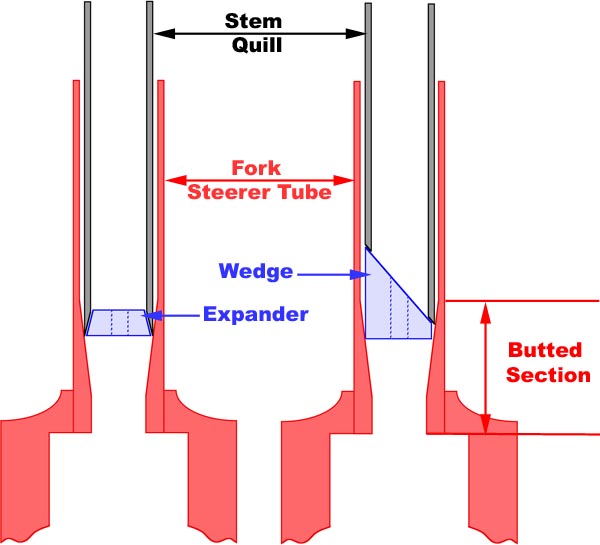
Conventional stems for most bicycles with threaded headsets fit inside the steerer of the fork, and use an expander/wedge to attach to the steerer. The stem diameter must match the inside diameter of the steerer, which is usually 1/8" smaller than the nominal headset size.
"Thread less"-type stems clamp on to the outside of the steerer, so they must match the outside diameter of the steerer, which is the same as the nominal headset size.
Stoker stems for tandems are very similar to "thread less" type stems, except that they clamp on to the seat tube of the rider in front, rather than to a steerer.
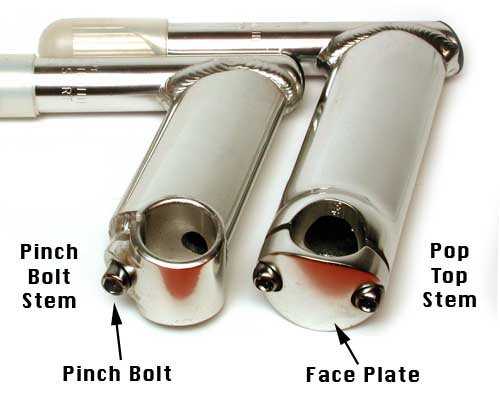
Pinch-bolt type stems are not in common use any more. They work with a fork that has a steerer with a slot cut into it, and a collar with a pinch bolt or quick release. These are most often seen on folding bicycles, because this design permits the use of a quick release.
"Adjustable" stems, (also known as "Major Taylor outriggers", after the cyclist who popularized them and possibly invented them), have the handlebar clamp unit mounted on a moveable part, permitting setting different amounts of forward extension.
Standard I.S.O. size, used on the vast majority of newer bicycles. This is sometimes incorrectly called "mountain bike" size.
25.8 mm
Unofficial in-between size used by some Italian handlebar makers for handlebars designed to be usable in either ISO (25.4) or Italian (26.0) size stems.
26.0 mm
Italian standard for drop bars, other bars made to fit Italian stems and some high-end aftermarket drop bars. This is sometimes incorrectly called "road" size.
26.4 mm
Older Cinelli and Cinelli copies. Cinelli changed over to 26.0 in 1998.
27 mm
Titan (obsolete).
31.8 mm
1 1/4"
Road oversized.
"Road" vs "MTB." A common, misunderstanding makes a false distinction between "road" and "mountain" size stem/handlebar fitting. The vast majority of bicycles use the standard ISO 25.4 mm/1" size, whatever style of handlebar is used. High-end road bikes assembled with custom parts groups often use expensive aftermarket bars and stems, which do predominantly come in the Italian size, since the major makers of expensive bars/stems for road bikes are Italian. Non-Italian parts makers attempting to compete for the high end market often offer both sizes.
Height / Angle / Reach
The range of handlebar positions available from a given stem depends on its height, angle and reach (extension.) Unfortunately, measurement procedures for determining these dimensions are not well-standardized in the industry, making it difficult to compare one stem with another based on the dimensions.
*
The height dimension is normally the overall height, measured along the line of the column.
Angle / rise may be measured either from the steering axis or perpendicular to it. Thus, a stem with the extension at a right angle to the column may be described either as a 90° or 0° stem.
Reach / extension is normally measured center-to-center along the direction of the extension.
The custom of measuring reach along the line of the extension means that two stems of the same nominal reach will provide a different distance between the steering axis and the handlebar center, if they have different angles.
Many newer stems use the "pop-top" attachment system for the handlebars, permitting the stem to be swapped without disturbing the handlebar grips/tape or brake/shift controls.
Note:Steerers are butted at the bottom, so the hole in the steerer is constant-diameter until near the bottom, then the walls taper inward in the butted section.
It is vitally important that the stem extender (or stem) not be inserted so far that the wedge is installed where the steerer is narrowing, or it could come loose unpredictably.
When this happens, only the edge/corner of the quill or wedge contacts the steerer, and it is trying to "grab" a slanted surface.
This is sometimes a problem on smaller frames if you try to insert the stem or a stem riser too far down into the steerer.
Illustration by Nicholas Flower
stem shifters
The term "stem" is sometimes also used to refer to a valve.