WikiPedalia is not endorsed or affiliated with the Wikimedia Foundation.
Internal
← Indicator Spindle, Indicator Rod · Interrupter Brake Levers →
Internal gearing:
Gear systems in which the gear shifting mechanism is built into the hub of the rear wheel. This is usually accomplished by the use of planetary gears.
The most widely known form of internal gearing is in the three-speed utility bicycle. 4-and 5-speed hubs have also been available for many years, but went out of fashion during the early '70's bike boom. Shimano, SRAM (formerly Sachs) and Sturmey-Archer have revived them, and also marketed 7- and 8-speed hubs, Shimano an 11-speed as well. SRAM also offered a 9-speed model but as of 2017 has abandoned the internal-gear hub market. Rohloff offers a 14 speed model. Fallbrook Technology's NuVinci hub is continuously variable, essentially offering an infinite number of "gears."
Internal gearing is usually heavier and more expensive than derailer gearing. Bicycles with internal gearing usually have fewer speeds than comparable bicycles with derailer gears, and the mechanical efficiency is sometimes less with internal gearing.
Internal gears are generally more reliable than derailer gears, especially for bicycles which are used in wet or dirty conditions, because the gear mechanism is all contained within the rear hub, out of harm's way. The other great advantage of internal gears is that they can be shifted even when the bicycle is at a stop. This feature makes them particularly suitable for use in stop-and-go city traffic.
Not all internal gears are built into the rear hub, there are also models that are built into the bottom bracket.
Internal gears may also be combined with derailers to produce "hybrid" gearing. This system is particularly useful for bikes with smaller-than-usual drive wheels, such as folding bikes and some recumbents, as it provides a way to get adequate high gears without requiring unusually large chainwheels .
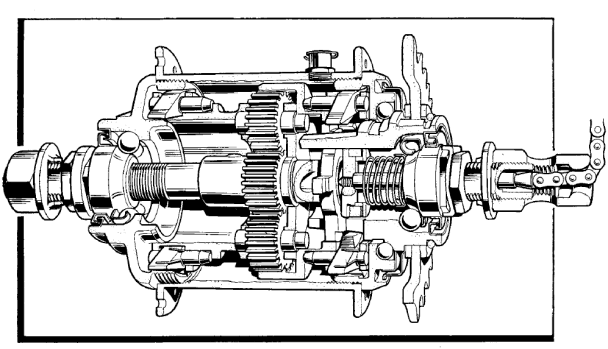
Classic Sturmey-Archer AW 3-speed Internal Gear Hub
Internal cable routing:
The practice of running gear or brake cables through the inside of a frame, instead of outside. This is usually done for the sake of making the bike look nicer. Unfortunately, internal cable routing usually degrades performance by increasing weight and cable friction. It can also make servicing the bicycle more difficult.