WikiPedalia is not endorsed or affiliated with the Wikimedia Foundation.
Sheldon Brown's Bicycle Glossary/I-L
- Idler
- IG ®
- Indexed Shifting
- Indicator Spindle, Indicator Rod
- Internal
- Interrupter Brake Levers
- Inverted tread
- Investment casting
- ISIS (International Spline Interface Standard)
- ISIS Overdrive
- Italian
- ISM
- ISO
- Jam Nut
- Japanese Industrial Standard (J.I.S.)
- Jockey pulley
- J.R.A.
- Jumper
- Junior Back → Kidback
- K-7
- Keel tube
- Keirin Racing
- Kevlar ®
- Key
- Keyed Washer
- Kick-back hub
- Kickstand
- Kidback
- Kit
- Klingon
- Kludge
- Knobby
- Kool Stop ®
- K.O.P.S. (Knee Over Pedal Spindle)
- KPa (KiloPascal)
- Krate ®
- Labyrinth Seal
- Lady's Bicycle
- Laprade Seatpost
- Lateral Stays
- Lawyer Lips, Lawyer Tabs
- LBS
- LED
- Left-Hand Thread
- L.F.
- Lightweight
- Limit-Stop Screws
- Linear-Pull Brake
- Locknut
- Lockring
- Lockwasher
- Loctite ®
- Look ®
- Lost-Wax Casting → Investment casting
- Low (Gear)
- Low-normal and High-normal
- Low-Profile
- Lowrider
- Lug

Idler
An idler is a pulley or roller that does not produce any mechanical advantage, nor transmit power to a shaft. Idlers are used to lead a chain around a bend (as in short wheelbase recumbents), or to take up slack in a drive chain (as in a tandem chain tensioner, or the pulleys in a derailer. Also see our article on how to make and idler out of a freewheel.
IG ®
Interactive Glide is an extension of Hyperglide, in which both sides of the sprockets are contoured to improve upshifting.
I.G. sprockets are very slightly thicker than Hyperglide ones, and some Shimano Hyperglide chains may hang up if used on an I.G. cassette. The slightly wider I.G. chains work on either type, as do SRAM chains. I.G was available only with 7-speed cassettes.
Indexed Shifting
Indexed shifting means that the shift control has positive detents or click stops that provide discrete positions corresponding to different gears. See friction shifting.
If your bike has old fashioned friction shifters, consider upgrading to a modern indexed system. This is a major, very worthwhile upgrade.
Internal-gear hubs have had index shifting throughout their history.
Parts must be matched for index shifting to work correctly: the shift control must match the derailer and cassette sprocket spacing, or the internal hub. Use of mismatched or misadjusted components can put your bicycle in a "between gears" condition.
Indicator Spindle, Indicator Rod

Sturmey-Archer term for the small chain and shaft which fit into the axle and connect the shift cable to the internal parts of many internal geared hubs.
Sturmey-Archer indicator spindles are of a number of different lengths, to fit different hubs. Also see our article about them.
Internal
Internal gearing:
Gear systems in which the gear shifting mechanism is built into the hub of the rear wheel. This is usually accomplished by the use of planetary gears.
The most widely known form of internal gearing is in the three-speed utility bicycle. 4-and 5-speed hubs have also been available for many years, but went out of fashion during the early '70's bike boom. Shimano, SRAM (formerly Sachs) and Sturmey-Archer have revived them, and also marketed 7- and 8-speed hubs, Shimano an 11-speed as well. SRAM also offered a 9-speed model but as of 2017 has abandoned the internal-gear hub market. Rohloff offers a 14 speed model. Fallbrook Technology's NuVinci hub is continuously variable, essentially offering an infinite number of "gears."
Internal gearing is usually heavier and more expensive than derailer gearing. Bicycles with internal gearing usually have fewer speeds than comparable bicycles with derailer gears, and the mechanical efficiency is sometimes less with internal gearing.
Internal gears are generally more reliable than derailer gears, especially for bicycles which are used in wet or dirty conditions, because the gear mechanism is all contained within the rear hub, out of harm's way. The other great advantage of internal gears is that they can be shifted even when the bicycle is at a stop. This feature makes them particularly suitable for use in stop-and-go city traffic.
Not all internal gears are built into the rear hub, there are also models that are built into the bottom bracket.
Internal gears may also be combined with derailers to produce "hybrid" gearing. This system is particularly useful for bikes with smaller-than-usual drive wheels, such as folding bikes and some recumbents, as it provides a way to get adequate high gears without requiring unusually large chainwheels .
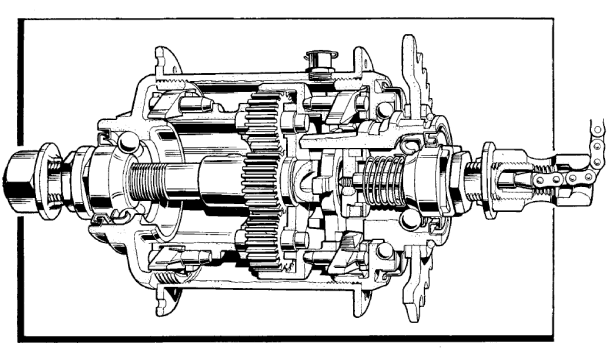
Classic Sturmey-Archer AW 3-speed Internal Gear Hub
Internal cable routing:
The practice of running gear or brake cables through the inside of a frame, instead of outside. This is usually done for the sake of making the bike look nicer. Unfortunately, internal cable routing usually degrades performance by increasing weight and cable friction. It can also make servicing the bicycle more difficult.
Interrupter Brake Levers
Secondary brake levers that "interrupt" the cable housings used with "æro" brake levers on drop handlebars. These allow the rider to brake while holding on to the top/middle section of the drop handlebar.
Instead of pulling on the inner cable, interrupter levers activate the brakes by pushing on the cable housing.
These are an updated version of the extension levers popular in the late '70s, without the drawbacks of the older designs.
This style of brake lever was first popularized by cyclocross riders, with the result that they're sometimes known as "cross levers" or "cyclocross levers" but there is actually nothing about them that makes them more suitable for cyclocross bikes than for any other drop bar application.

Inverted tread
An "inverted tread" is like the tread of most car tires, where the tread area may be visualized as a solid mass of rubber with grooves cut into it. "Knobby" tread, on the other hand, might be seen as a tire with thin rubber over the casing, but with knobs stuck on here and there.
Since tires are made by molding, not by cutting or sticking tread features on, this distinction is somewhat theoretical, and some tires have characteristics of both types.
"Inverted" tread tires typically have a more continuous contact area with the riding surface, so they give a smoother ride on pavement than knobby treads do. They can also give a better grip on loose, uneven surfaces than smooth tires do. They are mainly used as a compromise on- off-road tire. They don't grip as well in sand and mud as serious knobbies, and they are heavier and have more rolling resistance than smooth tires intended for paved surfaces.
Investment casting
Investment casting or "lost wax" casting permits casting of complicated shapes by using single-use plaster moulds that can be broken apart to free the cast part from the mould. This is an expensive process used mainly for high quality lugs and fork crowns.
This process is explained in detail at: https://juxtamorph.com/the-lost-wax-casting-process/
ISIS (International Spline Interface Standard)
When Shimano introduced its proprietary Octalink splined bottom bracket system, a group of other manufacturers got together to produce their own competitive splined system. This became ISIS. ISIS cranks and bottom brackets only work with each other, as do other splined systems.

ISIS Overdrive
ISIS Overdrive is an oversized standard for bottom bracket mounting to the bicycle frame. It uses a larger diameter thread, 48 mm instead of the ISO standard 1.37" (just under 35 mm.) Shell width can be either 68 or 100 mm.
The use of the ISIS Overdrive mounting dimension does not specifically require the use of ISIS splined cranks, but that is the usual configuration.
Italian
Italian bicycles are built to specific standards of threading and dimensions. Most parts on Italian-dimensioned bicycles are interchangeable with British/ISO dimensioned parts.
The major exception is the bottom bracket. Italian bottom brackets are 70 mm wide, as opposed to the usual 68 mm dimension of British/ISO and French bottom brackets. The cup diameter is also larger. Sometimes, bicycles which have damaged bottom-bracket threads are machined out to Italian size to eliminate the damaged threads. Italian bottom brackets, like the French, use a right-hand thread on both sides, so the fixed cup is prone to loosening up unless very securely tightened or secured with threadlock compound.
Italian threading is a curious mixture of metric and British. Diameters are specified in millimeters, but threads are in threads-per-inch! In addition, the thread angle is 55 degrees, as with the obsolete British Whitworth system, rather than 60 degrees as with U.S. and metric threads.
Italian freewheel and headset threads are the same as British/ISO, except for the thread angle difference. They may be interchanged, but you should not go back-and-forth between Italian and British/ISO headsets. Italian freewheels are basically extinct, so the issue is moot there. Italian-size handlebars/stems generally use a clamping diameter of 26 mm. Many high-end aftermarket drop handlebars and "road" stems also use this size even if not Italian-made.
ISM
Inter Spoke Milling ® A Mavic buzzword for rims that have been lightened by milling material from the inner circumference in the area between spoke holes. The idea is to save weight, without weakening the nipple support area. This approach results in a rim which is very un-aerodynamic.
ISO
The International Organization for Standardization. This is an international agency that is active in trying to rationalize bicycle design to make parts interchange more easily among bicycles made in different countries. Most ISO standards are compatible with British standards. These standards include:
- 1" x 24 tpi headset thread
- 1" (25.4 mm) handlebar/stem clamp diameter
- 1.375" x 24 tpi bottom bracket thread (left-hand on the fixed cup)
- 1.375" x 24 tpi freewheel thread
- 56 TPI spoke thread
- 1 mm axle thread
In the case of tires and rims, the ISO adopted the E.T.R.T.O. system, the modern system for designating tire and rim sizes, based on Bead Seat Diameter. This is explained in detail in my article on Tire Sizing.
Since the standards were adopted, innovation and product differentiation have resulted in a proliferation of parts that no longer conform to them, because these parts are designed entirely differently. This has occurred with spokes, headsets, bottom brackets, chains, sprockets...
Jam Nut
A thin lock nut.
Japanese Industrial Standard (J.I.S.)
Less-expensive Japanese bicycles use J.I.S. sized headsets, better ones use Campagnolo-sized headsets. Frames and forks built for J.I.S. headsets can be machined to fit standard Campagnolo-type headsets.
J.I.S. fork crown seats are 27 mm in diameter, instead of 26.4 mm
J.I.S. head tube inside diameter is 30 mm, instead of 30.2mm
J.I.S. square-taper bottom-bracket axles use a marking system which is consistent across numerous brands.
Jockey pulley
The upper pulley on a rear derailer. This is the pulley that actually guides the chain from one sprocket to another. Shimano jockey pulleys are designed with a "Centeron®" mechanism that allows a small amount of sidewards motion to compensate for imprecise index adjustment.
J.R.A.
Industry slang for "Just Riding Along." Refers to disingenuous customers making questionable warranty claims, as in "I was just riding along when suddenly my fork bent backwards."
Jumper
African-American term for "derailer".
K-7
One of my favorite French puns. The letter "K" is pronounced "kah", the number "7" is "sept" (the "p" is silent, like the "p" in swimming.) Thus, "K-7" is "kah-sept" or "cassette." I first encountered this in a French electronics catalogue, and it took me quite a while to figure it out. As far as I know, the French only use this abbreviation for tape cassettes, but I have fallen into the habit of using it as a shorthand for Freehub cassettes.
Keel tube
The large tube at the bottom of a tandem frame that runs between the two bottom brackets. Also known as "boom tube."
Keirin Racing
A popular Japanese form of track racing. Keirin races are partially paced by motorcycles. This is one of the few human athletic events at which pari-mutuel betting is legal.
The governing body of Keirin racing is N.J.S. (Nihon Jitensha Shinkokai-the Japanese Bicycling Association.)
For more details, see the Wikipedia entry for Keirin.
Kevlar ®
A very strong artificial fiber, used in bullet-proof vests and bicycle tires. Kevlar is used in tires two different ways, for two different purposes:
- Kevlar beads are used on some high performance tires. Replacing the normal wire bead with Kevlar saves about 50 grams per tire. Kevlar-bead tires have the additional advantage of being foldable, making them popular as emergency spare tires with touring cyclists. Kevlar-bead tires are somewhat harder to mount on a rim, and are more likely to blow off than wire-bead tires. They work best on "hook edge" rims.
- Kevlar-belted tires have a layer of Kevlar under the tread surface, with the purpose of making the tire more resistant to punctures caused by small. sharp objects, such as thorns and glass slivers. Kevlar-belted tires have slightly higher rolling resistance, price and weight than corresponding tires without the belt.
Key
In British usage, "key" is often used as a synonym for what an American would call a wrench. Even in the U.S., the term "Allen key" is sometimes used for an Allen wrench
"Key spoke" is a term I coined to designate the first spoke installed when building a new wheel.
Keyed Washer
A keyed washer is a washer with a special-shaped hole that fits over a special shaft. It can slide, but not turn. The usual set up is to have a groove in the axle or shaft. A washer's hole will have a small tang that fits into the groove. This is almost always used in headset and pedal bearings. It used to be common in hub bearings as well, but has fallen out of favor for that application.
Another type of keyed washer fits a shaft that is round but has one (or more) flat side(s). French forks usually use this system, with a simple filed flat on the back of the steerer.
Kick-back hub
A two-speed hub, usually with a coaster brake, which switches between its two gears each time the pedals are rotated backward. This system doesn't require any hand controls or cables. Kick-back hubs were formerly made by Bendix and Sachs, and were popular on folding bicycles and inexpensive tandems, and are currently in production by Sturmey-Archer.
Bendix (U.S. company) made 3 models, distinguished by colored stripes running around middle of the hub shell.
- The "blue band" model offered direct drive plus a higher gear.
- The "yellow band" and "red band" flavors offered direct drive plus a lower gear. The difference between the yellow and red models is in the brake. The red band had a disc-type brake, like the old New Departure coaster brakes, while the yellow band used a pair of brass shoes pressing against the inside of the shell, as with newer Bendix and other "modern" coaster brakes.
Note that the sprockets are not interchangeable on these hubs: they only took a 20 tooth sprocket.
Sachs/Torpedo (West Germany) also used to make a kick-back hub. These were most commonly installed on folding/take-apart bikes, where they offer the advantage of not requiring any cables to run from the front to the rear of the bike.
The Sachs/Torpedo hub, unlike the Bendix, did allow sprocket interchangeability, using the same 3-splined sprockets used by most other multi-speed hubs (Sturmey-Archer, Shimano, SRAM/Sachs, etc.) Sprockets are available from 13-24 teeth. The Sachs/Torpedo unit is also quite a lot smaller than the Bendix models. SRAM, which purchased Sachs, introduced a kick-bakc hub shortly before it stopped producing internal-gear hubs.
Sturmey-Archer currently (2017) makes kick-back hubs with and without a coaster brake.
Kickstand
A prop for holding a bicycle upright when it is parked. These are called kickstands because they are operated by the foot. There are several kinds:
- Clamped to the chainstays just behind the bottom bracket, and supporting the bicycle leaning to its left.
- Also leaning the bicycle to the left, but attached to a special bracket in the bottom-bracket area.
- Mounted behind the bottom bracket and with two legs either side that stow under the chain stays. This type holds the bicycle upright,
- Mounted to the left chainstay and seatstay just if front of the rear hub. This is the only type of kickstand that does not interfere with a crank. If the bicycle is rolled backwards with the kickstand down, the others can be damaged, or damage the chainstays.
Kidback

An adjustable "bottom bracket" which clamps on to the rear seat tube of a tandem to permit a child ("stokid") who cannot reach the normal stoker pedals to pedal.
Kit
A set of all the parts needed to turn a frame into a ready-to-ride bicycle. See "group."
Klingon
Wheel sucker. Term popular with tandemists, generally refers to solo cyclists who draft tandems.
Kludge
A quick and dirty, inelegant solution to a mechanical or software programming problem, cobbled together in haste or for lack of anything better that is conveniently available. Pronounced "klooje."
Knobby
A tire with an "aggressive" tread pattern, that is, one with knobs or bumps of various shapes, designed to dig into soft surfaces for better traction. Knobby tires get better traction on soft surfaces such as mud, gravel, snow, and dirt, compared with smooth treaded tires.
Knobby tires perform extremely badly on paved surfaces. The knobs greatly increase rolling resistance, and create annoying vibrations. They also corner badly on pavement, due to squirm.
Kool Stop ®
A manufacturer of brake shoes which using Mathauser technology under license from Mathauser.
K.O.P.S. (Knee Over Pedal Spindle)

This refers to a popular fitting theory that states: When the cranks are horizontal, a plumb line straight down from the front of the rider's front knee should intersect the spindle of the pedal. This condition is achieved by adjusting the front/back position of the saddle.
This approach is quite popular with racing coaches, but it is by no means clear that this is a good setup for general cycling. Many recreational riders prefer a more rearward saddle position than this, with the extreme case being the recumbent position.
Some triathletes and time trialists prefer a more forward position. This is generally an approach that is used with æro type handlebars and arm rests.
See also Keith Bontrager's article "The Myth of K.O.P.S." and my article on Frame Sizing
KPa (KiloPascal)
A unit of pressure, equal to .01 BAR or 0.145 PSI.
Krate ®
Schwinn trademark for a family of wheelie bikes. These have become quite valuable to collectors.
Labyrinth Seal
A bearing seal that adds no friction, because there is no seal contact between the revolving part and the stationary part. Contaminants can't easily enter the bearing because the baffles of the labyrinth seal deprive them of a straight route inward.
Labyrinth seals work very well as long as the bearing assembly is not immersed.
The illustration shows a standard hub, but similar seals are used on some

other bearing applications as well.
Lady's Bicycle
In the Victorian era, when the bicycle had its first popularity, women were forced to wear long skirts, which prevented them from riding conventional diamond-frame bicycles. This led to the development of the "lady's bicycle" which eliminated the top tube from the frame, adding a second down tube for strength.
Since hardly anybody rides in a skirt anymore, this inferior design is pretty-much obsolete. Conventional diamond frames have several advantages over the Victorian lady's bicycle. They are:
- Lighter
- Stiffer
- Stronger
- Easier to pick up and carry over stairs, etc.
- Roomier, to mount useful accessories: bottles, pumps, locks, etc.
See also "mixte."
Laprade Seatpost

Laprade was originally a brand name, but has become a generic term for seatposts with a built-in clamp that uses a vertical Allen bolt to clamp the saddle rails. Typically,, the tilt of the saddle is adjustable by loosening this same bolt so the convex, toothed underside of saddle-clamp assembly can be slid backward or forward on a matching, concave, toothed surface. This type of seatpost is much easier to adjust than the classic Campagnolo two-bolt seatpost, but can be adjusted only in (small) steps.
Lateral Stays
Thin tubes that run in pairs alongside the front part of a frame, and typically extend past the seat tube to the rear fork ends. These are most commonly seen on mixte frames and on older tandems, although they are also used on a few large-sized diamond frames intended for heavy-duty use.
Lawyer Lips, Lawyer Tabs
Because some bicycle users are competent enough to remove their front wheels but not competent enough to secure them properly when they reinstall them, virtually all new bike purchasers have been deprived of the handy function of quick-release front wheels.
This has been done by encumbering fork ends with extra hardware, ridges or lumps that keep the wheel sort-of attached even if it has been installed by someone who doesn't know what he or she is doing. Unfortunately, this means that the quick-release mechanism must be re-adjusted each time it is used, seriously slowing down the operation.
Since this extra stuff was installed as a defense against frivolous lawsuits by ambulance-chasing shysters, the extra bumps are sometimes known as "lawyer lips" or "lawyer tabs."
As "lawyer lips" have become the norm, they have gradually become more important than they originally were, for two reasons:
- The prevalence of these secondary retention systems in front, and vertical dropouts in the rear has caused the proliferation of inferior skewer designs that are cheaper to manufacture, but much less secure than traditional skewers. See my Article on Quick Release Skewers.
- The introduction of disc brakes has caused increased vulnerability of the front axle and skewer, due to the disc brake applying an ejection force that tends to pull the axle out of the fork. See James Annan's article on disk brake wheel ejection.
LBS
Local Bike Shop
LED
Light-Emitting Diode, a solid-state device which generates light when an electric current is passed through it. Light-emitting diodes can be far more efficient than incandescent bulbs, increasing battery life and light output of bicycle lights. The first practical LEDs for bicycle lights produced red light and were used in taillights. There was an unintended and unfortunate side effect, that many bicyclists, out of convenience and because of fear from the rear would use only a taillight and no headlight. Beginning around 2005, high-efficiency white LEDs became available, LED headlights became common, and more bicyclists began using headlights. See Marty Goodman's article on the history of bicycle lighting.
Left-Hand Thread
Most threaded fasteners are right-threaded, so you turn them clockwise to tighten them. Some parts which are used in conjunction with rotating shafts would tend to unscrew themselves if they threaded normally, so they are threaded in the opposite direction. This is called a "left thread," "left hand thread" or "reverse thread."
Left-threaded fasteners are turned counter-clockwise to tighten them.
Left threads are found on left pedals, some bottom-bracket parts, internal parts of freewheels, and sprockets that thread onto older freewheels from the left side.
Left-side pedals and right-side bottom bracket cups use left-hand threading because of the phenomenon called "precession." It is somewhat counterintuitive, because the direction of rotation caused by the precession is opposite the (much smaller) torque exerted by bearing friction.
See the Pedals entry in this Glossary , and Jobst Brandt's article on Left-Hand Threads on this site for a detailed explanation of precession.
Spoke nipples and the expander bolts that hold bar-con shifters in place often appear to have left threads, because they are approached from the opposite direction of most fasteners.
L.F.
Large-Flange or Low-Flange (hub). This is a source of confusion, since these two meanings are opposite. For clarity, this abbreviation should be avoided.
Lightweight
Traditional U.S. bicycle industry term for bicycles with tires narrower than about 1.5".
Limit-Stop Screws
The limit stops are two screws that set the limits of how far the derailer can move from left to right. They are usually located on the back of the parallelogram; sometimes they face outward to the bicycle's right. The end of a screw bumps into internal parts of the parallelogram when the derailer has moved all the way in the direction controlled by that screw.
 See my article on Derailer Adjustment for more details.
Linear-Pull Brake
Another term for a direct-pull brake.
Locknut
A nut which is tightened against another nut to keep it from loosening up. Often, but not always, there will be a key washer between the locknut and the cone or other part it secures.
Locknuts are used to secure bearing adjustment of most hubs, headsets, pedals and sidepull brakes. Most hubs use locknuts to secure the cones so that they will stay in adjustment. These locknuts are the outermost parts which are screwed onto the axle, and their outer surfaces press against the insides of the fork ends of the frame. The locknuts are therefore the reference point by which axle width and dishing are measured.
Lockring
A thin locknut used to keep A threaded assembly from coming unscrewed. Conventional bottom brackets use a lockring on the adjustable cup to make it hold its adjustment.
- Hyperglide cassettes and freewheels use a splined lockring to hold the sprockets to the body.
- Fixed-gear hubs use a left (reverse) threaded lock ring to keep the sprocket from unscrewing when the cyclist resists the motion of the pedals.
Cassette and Fixed-Gear (Track) Hub Threaded Outer Sprocket/ Lockring Threading
| Brand and model | Threading | Note |
|---|---|---|
| Campagnolo cassettes (all threads external on lockring) | ||
| 8-speed | 29 x 1 mm | Different outside diameters for 11T or 12-14T outer cog |
| 9- and 10-speed 1996-1999 | 26 x 1 mm | Different outside diameters, for 11T or 12-14T outer cog |
| 9- and 10-speed 2000- | 27 x 1 mm | Different shapes: may not be compatible |
| 11-speed | 27 x 1 mm | |
| Shimano cassettes | ||
| Uniglide (most) smallest sprocket | 1.37 x 24 TPI external on hub | Threading same as track cogs, SunTour New Winner 7-speed outer sprocket, English BB lockring |
| Dura-Ace Uniglide, 11T smallest sprocket | 32 mm (approx.) x 24 TPI external on hub | Smaller thread diameter to permit 11T outer sprocket. |
| Hyperglide lockring | 30 mm (approx) x 24 TPI external on lockring | Different outside diameters for 11T or larger sprocket |
| Capreo/Chosen lockring | 22 x 1 mm Capreo, 22 mm x 30 TPI Chosen (approx), external on hub | Smaller diameter to work with 9T sprocket |
| Fixed Gear lockring (Left threaded) | ||
| Campagnolo, Phil Wood | 1.32 vx 24 TPI | |
| English | 1.29 x 24 TPI | Fits most U.S., English, and Asian fixed-gear hubs. Also used on older English coaster brakes with threaded sprocket |
| French | 33 x 1 mm | |
Lockwasher

A washer with directional sharp edges to make a nut or bolt less likely to loosen up due to vibration. The edges are angled to work sort of like pawls, permitting the fastener to be tightened without undue friction, but biting into the fastener and/or surface of the part when the fastener tries to rotate in the loosening direction.
Loctite ®
A liquid adhesive for screw threads. Loctite and similar "threadlockers" are liquid as long as they are exposed to oxygen, but when you put them on screw threads and screw the parts together, oxygen can no longer get to the Loctite, so it hardens up, keeping the threads from loosening up to vibration and the like.
Threadlockers are mainly used for threads that are not intended to be fully tightened: adjustment screws and the like.
There are very few good applications for threadlockers in bicycle work. They include:
- Cantilever brake mounting bolts (front especially.) If these are overtightened, they can "mushroom" the ends of the cantilever bosses, causing the brake to bind up.
- Fixed bottom bracket cups on French or Italian threaded frames French and Italian fixed cups are threaded in the wrong direction, so there is a tendency for them to loosen up in use.
- Mounting rings for some cartridge bottom brackets Many mounting rings are tightened only against the ends of the bearing cartridge rather than having a shoulder or lockring that bears against the end of the bottom-bracket shell.
- Radial spokes.
Look ®
A French manufacturer of bicycle components, accessories and carbon-fiber frames and forks. Look made the first clipless shoe-pedal system that was successful in the market. Look caters mostly to the road-racing market.
Low (Gear)
A low gear is one in which the pedals move rapidly compared to the speed of the wheels.
Low gears make the pedals easy to push, but you need to turn them faster to get the bike to move at a good speed.
Low gears are achieved by using small chainwheels and large rear sprockets.
Low gears are used for climbing hills, or for starting up from a stop.
Low-normal and High-normal
Modern derailers are spring loaded, pulled one way by the spring and the other way by the control cable. A "low-normal" derailer is one in which the spring pulls it toward the lower gear(s). If you release the tension on the cable, it will shift to the lowest gear.
Up until the late 1950s, all spring loaded derailers were low-normal. Campagnolo's pioneering parallelogram-type rear derailer was high-normal, and most rear derailers made since then have been of the high-normal type.
The major advantage of high-normal rear derailers is that, when used with a low-normal front, both levers move in the same direction for double shifts. This makes it easier to perform a double shift with down-tube shift levers.
The major advantage of low-normal derailers is that they generally downshift a bit better than high-normal units.
Since the late 1990s, Shimano has attempted to revive the low-normal rear derailer design, using the trademark "RapidRise." This has met with increasing acceptance by cyclists.
Sun Tour used to make high-normal front derailers. The principal advantage of this was that the front and rear shift levers moved in the same direction to either raise or lower the gear, less confusing for beginner cyclists.
Low-Profile
- Low Profile Cantilever Brakes
Traditional cantilever brakes have arms that stick out fairly far to the side. These protruding arms sometimes get in the way of pannier bags, and the rear brakes sometimes interfere with the rider's heels on smaller frames. As mountain bikes became popular in the 1980s, the heel clearance issue became a serious problem, because mountain bikes generally used smaller frames than traditional designs, placing the seatstays lower. The riders' heels; banging into the ends of the brake cantilevers became a real concern.
The industry responded with a re-designed cantilever whose arms were angled up higher, and didn't stick out so far to the side. This fixed the heel clearance problem, but introduced problems of its own.
With low profile cantilevers, the mechanical advantage decreases as the brake shoe moves inward toward the rim, an undesirable characteristic which causes the braking performance to deteriorate sharply as the pads wear down.
See also my article on Cantilever Geometry. - Low-Profile Cranks
Traditional cranks run roughly parallel to the bicycle's centerline from the bottom bracket to the pedal. Most newer cranks use the "low-profile" design: the bottom bracket is made shorter, and the crank runs outward at an angle from bottom bracket to pedal, giving improved heel clearance for riders who tend to pedal splay-footed.
Note: That a crank is "low-profile" says nothing about its tread width (a.k.a. "Q factor.") In fact most "low profile" cranks have fairly wide tread, but this has nothing to do with the "low-profile" design.
The trend toward wider tread resulted from the wider chainstays introduced with mountain bikes, and also the additional clearance required to keep the right crank from rubbing against the cage of the front derailer (newer front derailers optimized for triple chainwheels require more crank clearance than older front derailers did.)
Lowrider
- Lowrider racks are front pannier racks designed so that the panniers attach below the top of the front wheel, so that their center of gravity is low and close to the steering axis of the fork. The purpose is to improve stability compared with the typical earlier setup that used high-mounted rear panniers. Lowrider racks were first sold by Blackburn Designs, and their design was based on experimentation by Jim Gentes, who went on to found Giro. See article by John Schubert
- Lowrider bicycles are a fad design of bicycles, inspired by the wheelie bikes of the 1960's with very long wheelbases. They are built purely as an exercise in styling, with no real concern for riding qualities. Some of them, in fact, are not rideable, because the cranks are so close to the ground that the pedals cannot turn around. They commonly feature lots of chrome or gold plating, 72 spoke wheels, sometimes steering wheels instead of normal handlebars, and springer forks. These toy "bicycles" should not be confused with recumbents, which are real bicycles.
Lug
A lug is a socket that forms the junction between two or more frame tubes. Traditional bicycle construction uses steel tubes and lugs, joined together by brazing or silver soldering so that the space between the tube and the lug fills up with molten brass or silver alloy. Some aluminum or carbon fiber bicycles also use lugs, with glue instead of the brass or silver.
Some frames use internal lugs, with a necked-down section that fits inside of the tube, rather than having a socket that the tube fits into.