Shimano terminology for the screw that regulates the tension of the upper-pivot spring of a rear derailer. It should be adjusted with the bicycle in its lowest gear. Loosening this screw allows the jockey pulley to swing up closer to the cluster, improving shifting.
If the B-tension is too loose, however, the jockey pulley will bump into the largest rear sprocket, causing noisy running and possible shifting problems.
See my article on Derailer Adjustment for more information on this and other derailer adjustments.
A ball bearing is a type of bearing in which the turning part is connected to the non-turning part only by balls that roll between the two parts. Ball bearings are used in bicycle bottom brackets, freewheels, headsets, and hubs. They are also occasionally used in derailer pulleys and brake calipers.
A wide, low-pressure tire, typically 2.125" (54 mm) wide. The development of balloon tires and "streamlined", curved-tube frames created a mini bike boom in the 1930s. These bicycles are pretty much indistinguishable from modern cruisers, and were the ancestors of the mountain bike, which was built around the popular-sized balloon tires.
A type of seat popular on wheelie bikes, which extended well back from the seat post. The rear end of the seat was supported by an upside-down "u" shaped brace called a "sissy bar" which attached to the rear axle or to the rear fork ends. Some banana seats had spring suspensions built into the sissy bars.
Sun Tour trademark for derailer shift levers which mount in the ends of (usually) drop handlebars, replacing the normal end plugs. More formally known as "handlebar-end shifters" or "bar-end shifters," but not simply as "bar ends."
A form of "helper spring" for rear derailers. This is a fitting which slips over the rear derailer cable just in front of where it disappears into the final loop of housing that leads to the derailer. It includes a length of rubber tubing. The cable runs down the middle of this tubing, and a setscrew clamps one end of the tubing to the cable. This serves two purposes:
It completely seals this vulnerable entry point against schmutz thrown up by the front tire.
The rubber tubing acts as a "helper spring" to retract the cable smartly when upshifting. This can provide better upshifting on any bicycle which upshifts sluggishly due to excessive friction or a derailer with a weak spring.
The Bead Seat Diameter (B.S.D.) is the crucial dimension that determines whether a particular tire can fit onto a particular rim. It specifically refers to the "shelf"-like area inside the rim where the tire's bead sits.
The Bead Seat Diameter is the fundamental dimension used in the ISO/E.T.R.T.O. system of tire and rim sizing. This is the great virtue of that system, compared to all of the older systems that referred to the tire's outside diameter, with no specific reference to rim diameter or to the rim/tire interface.
A bearing is the point of contact between a turning part and a non-turning part. A good bearing assembly has little or no play, and as little friction as possible.
A steel ball that is part of a ball bearing assembly. Most front hubs use 10 3/16" balls on each side; Most rear hubs use 9 1/4" balls on each side. Most bottom brackets use 11 1/4" balls on each side.
Bearing balls are made in batches, and within a batch the size is very carefully controlled. From one batch to another, however, there can be a considerable variation in actual size of balls of the same nominal size. For this reason, balls from different batches should never be mixed in the same bearing.
Bearing balls come in several quality grades, designated by numbers. Grade 25 is the best that is available for bicycle applications. Grades 100, 200, even 300 are commonly used in bicycles.
A linkage in the form of a right-angled lever, with the pivot at the corner. Shimano 3-speed hubs (and some Sturmey-Archer 5-speeds) use a bellcrank to translate a pull on the gear cable into a push on a loose-fitting pushrod that fits into the axle.
A bellcrank used to shift a Sturmey-Archer 5-speed hub.
Sheldon Brown points out a bellcrank that rings a bell, Chevreuse, France, July, 1989. Photo by John Allen
From time to time toothed belts are proposed as an alternative to chain drive. A belt may be lighter than a chain, though the pulleys are wider and so, heavier than sprockets for a chain. The major advantage touted for this system is that it is cleaner than a chain.
There are serious disadvantages to this approach, however:
Belts can't be opened and re-closed as chains can, so it is not possible to fit one to a standard diamond frame, unless you cut the frame open, because the belt has to be looped through the triangle formed by the right chainstay, right seat stay and seat tube.
Belts can't be lengthened/shortened as chains can, making it difficult to customize the gearing by going to a different sprocket/chainring size.
Belts bend instead of pivoting, and are less efficient than chains.
Belts are stretchy. To avoid skipping, they have to be kept tensioned, further reducing efficiency.
Belts can't be made as narrow as chains, so they do not lend themselves to derailer gearing.
As with shaft-drive systems, all of the benefits touted for this system are also attainable with an enclosed chain drive.
[Update, June 2012: Gates Carbon Drive carbon-fiber reinforced belts are currently in vogue. They don't stretch as much as other belts and so, don't have to be tensioned as much. However, carbon fiber is brittle, and these belts will soon snap if fibers have been damaged -- if the belt is "levered" onto a pulley from the side, or if a twig or trouser cuff is caught between the belt and a pulley. A Gates belt (and probably others) should be fitted over the pulleys loose, and tensioned by moving the pulleys farther apart, so the belt is subjected to stress only lengthwise, as in normal operation. -- John Allen]
Also see R&E Cycles comments on belt drive for the tandem synchronizing chain.
A very old company, originally known as a maker of coaster brakes, but later diversified into the automotive industry, where they are particularly involved with starters. (The retractable drive gear on an automotive sprocket is commonly called a "Bendix gear".) The company is still going strong, but the bicycle division was sold off some years ago.
A defunct British maker of derailers. These were popular in the middle of the 20th century. Benelux rear derailers used a telescoping assembly and conical return spring, and attached to the chainstay. Derailers with a pantograph (parallelogram) mechanism replaced these.
Noun: bicycle; motorcycle. Many cyclists object to verb-based derivatives of "bike" i.e. "to bike", "biking", "biker"...(Bikers ride Harleys, people who ride bicycles are cyclists.)
In the early-to-mid 1970's, bicycle sales boomed, after several decades when the bicycle was commonly regarded as a child's toy.
The Bike Boom was partly related to the Baby Boom, as Boomers were starting to enter adulthood in large numbers. Other factors were the popularization of 10-speed derailer-equipped bicycles, and increasing environmental awareness, with the hope that bicycling would substitute for much motoring. The bike boom is often attributed to the oil crisis of 1974, but in fact, it was already waning then -- see data in 1978 study republished by John Allen.
A similar bike boom had occurred in the mid-1890s when the safety bicycle with pneumatic tires replaced the high-wheeler.
It is important to distinguish bicycle sales from bicycle use. As bicycles are durable goods, a bike boom tends to saturate the market and then to be followed by a bust. The actual levels of bicycle use are more stable.*****
A type of non-round chainwheel introduced by Shimano in the 1980's. It is designed to provide a more natural motion of the foot, better off-road traction, and to reduce stress on the knee.
Most tires use rubber blended with carbon black, which makes the tread more durable and improves traction.
In the 1950's, some tire companies started using "gum" rubber (without the carbon black) for the sidewalls, in the interest of improved flexibility and lowered rolling resistance. Later, "skinwall" tires became popular, tires with nearly naked cloth sidewalls, with just a bit of rubber to hold the cords together. For many years, tan sidewalls, whether gum or skin, were a sign of high-performance tires, and blackwalls were a sign of cheapness.
In the early 1990s, there was a styling fad for tires which were basically skinwalls, but looked like the old blackwalls. Although the marketing departments of tire companies tried to make this out as some kind of advantage, it is fundamentally a styling issue, as with whitewalls.
A spoke that has been flattened in the direction of rotation for improved ærodynamics. "Bladed" spokes are so wide that they will not fit through the spoke holes of a standard hubflange. The usual solution to this problem is to file a notch or two to enlarge each spoke hole. This is very labor-intensive, and risks creating a stress riser which can lead to flange failure.
"Brake block" is another term for a brake shoe or pad for rim brakes.
A "block generator" is a combined generator/headlamp unit, designed to mount on the front fork. It has the advantage of not needing any wiring. Block generators are no longer generally available due to liability concerns. Since they mount to the fork blade, there exists a possibility that, if not properly secured, they could slip down and fall into the spokes, locking the front wheel and causing a crash.
An obsolete type of chain, formerly popular with track racers.
Block chain had solid blocks as inner links, without rollers. It had a 1" pitch with 3/16" wide blocks, the same as the "skip link" roller chain that appeared on the market about 1930 to replace it.
The remaining stock of block chain was coveted by track riders who believed it was the only chain strong enough to withstand their imagined strength. When the stock of block chains finally ran out in the late 1970's, it was replaced by 1/2" pitch 3/32" wide chain, as used with derailers, although track riders still prefer a 1/8" wide chain, believing they are stronger than other riders. MTB's with 22 tooth grannychainwheels produce several times the chain tension any track rider can muster.
An 8-tooth sprocket for 1" pitch chain (left) is equivalent to a 16 for standard 1/2" chain.
Bicycle Motocross, a type of dirt-track racing, primarily for children and teenagers. Competitors usually ride 20" wheel, single speed bicycles with a freewheel and a rear hand brake. Races, called "motos" usually last less than two minutes, and feature jumps. High-level BMX races mostly hinge on getting a good start off the line, which, for some reason, is called a "hole shot" BMX tracks use mechanical starting gates that fall forward under the riders' wheels when released.
Common 5-bolt double-chainwheel sets use 130 mm or 110 mm diameters.
Modern triple chainwheel sets have two diameters, a large one for the two outer chainrings, and a smaller diameter, with a separate set of bolts, for the granny ring.
Full-size triples usually use 110 mm/74 mm, or 130 mm/74 mm for newer "road triples." Campagnolo uses 135 mm/74 mm. Compact triples commonly use 94 mm/58 mm.
Some crank sizes:
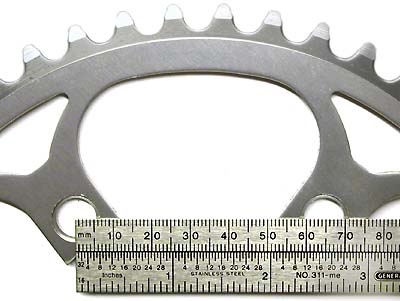
"C-C" is the distance between adjacent stack bolts. This is usually easier to measure directly than the actual Bolt Circle Diameter.
Measuring BCD: This 110 mm BCD ring measures 64.7 mm center-to-center (or, from left side to left side, or right side to right side --easier to measure).
Multiplying this dimension by 1.701 will give you the actual BCD for a 5-bolt chainring. Use 1.155 for 3-bolt chainrings.
If there is an even number of holes, diameter can be measured directly unless something is in the way -- usually, the crank. Then measure at two adjacent bolt holes, and multiply by 1.414 for 4-bolt chainrings and 2.000 for 6-bolt chainrings.
A fastener with external threads, usually with a hexagonal head. Strictly speaking, it's only a bolt if the threads do not extend the full length of the shaft.
If the threads do extend full length, technically it is a "screw " but only pedants insist on this distinction.
A very few high-end hubs actually do use bolts, usually with an Allen head. Among these are American Classic, Bullseye, Phil Wood and White Industries.
The earliest type of bicycle, from the mid 19th century. A boneshaker had wheels of roughly equal size, like a modern "safety" bicycle, but the pedals were directly connected to the front hub, as with a high wheeler.
Boneshakers existed before the invention of Dunlop'spneumatic tire, and had wooden or iron wheels, with iron or (later) solid rubber tires. This caused them to provide a very harsh ride, hence the name.
The boneshaker evolved over time into the high wheeler, with the drive wheel getting larger and larger, the rear wheel shrinking down.
A television set. (Boob: "A stupid or foolish person; a dolt" (who watches too much TV); Tube: the cathode ray tube of a TV receiver.)
Some misguided souls use this term to describe the keel tube of a tandem frame. This makes no sense semantically. It probably arose because somebody couldn't think of one of the several more descriptive terms, and picked something cute-sounding out of the air. It is to be hoped that this foolish term will disappear into the dustbin of history.
The bosses of cantilever brakes and centerpull brakes can flex outward when the brake is applied hard. This contributes to a "spongy" feeling to the brake lever, and, in some cases, the extra flex may permit the brake lever to bottom out against the handlebar.
A "brake booster" is a metal bridge that connects the outer ends of the two cantilever bosses, holding them in position and greatly reducing their tendency to flex under load. A booster resembles an inverted "U", as it curves up and over the tire.
A temporary patch to cover a large hole or cut in a tire. A boot does not need to be air-tight, but needs to be sufficiently strong and stiff to prevent the inner tube from bulging through the hole in the tire. Many things may be used to boot tires, including leather, currency, food wrappers, etc. Patches intended for tube patching will not usually do a good job, because they are stretchy and will blow through the hole just as an inner tube would.
The best material for boots is a piece cut from an old thin-tread tire, preferably a tubular. Many cyclists carry such a piece of tire for this purpose.
A boot does not need to be glued in place. It will be held in position by the pressure of the inner tube.
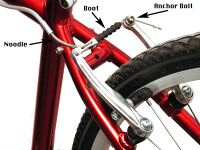
V brake bootAn accordion-like rubber sealing device to cover the connection where one part slides into another, preventing dirt from entering. This type of "boot" is commonly seen on the legs of suspensionforks, and on the cables of direct-pull cantilever brakes.
Shift lever bosses are brazed-on pivots for down-tube-mounted shift levers. Most newer "road" bicycles have the shifters mounted on the handlebars, so they use the old-style lever bosses as attachment points for housing stops
Older style freewheelpullers had two (or four) protruding bosses that engaged the notches of the freewheel body. This system was prone to failure when removing freewheels that were unusually tight. The development of splined freewheel removal systems made this obsolete
The part of the frame around which the pedal cranks revolve, also the bearings and axle assembly that runs through the bottom bracket shell of the frame.
A conventional cup-and-cone bottom bracket. The lockring wrench is about to loosen the lockring, the pin wrench is engaging two of the holes in the adjustable cup
A cartridge bottom bracket. The splined tool is shown above the bottom bracket. The crank would need to be removed to actually use the tool.
An old American term for "bottom bracket" is "hanger". This is usually used in connection with one-piece cranks.
Bottom brackets come in different sizes, according to the nationality of the frame. The table below is for threaded bottom-brackets. For the Ashtabula and other unthreaded bottom brackets, see the unthreaded bottom-bracket cribsheet.
The overwhelming majority of bicycles in current production. British and I.S.O. are interchangeable.
Shimano Hollowtech II, FSA MegaExo, RaceFace X-type
ISO
right
left
90 mm, 95 mm including cups
External cups for cartridge bearings fit British/ISO threaded bottom brackets or unthreaded shell. 24 mm spindle, spacer to use 6805 bearings with 25mm I.D.. Bottom bracket shell must be faced so cups are parallel.
Track/Coaster Brake Traditional One-Speed Most internal gear hubs
40.5-42 mm
Older bikes with 110 spacing would be on the smaller end of this range Newer bikes with 120 mm spacing normally use 42 mm
Road Double
43.5 mm
Shimano spec, measured to the midpoint between the rings. with typical 5 mm chainring spacing, this puts the inner at 41 mm, the outer at 46 mm.
Road Triple
45 mm
Shimano spec, measured to the middle ring.
Singlespeed MTB Alternate
47.5 mm
White Industries ENO hubs use this chainline, which lines up with the middle position of a typical MTB triple. It's also fairly close to the outer position of a typical "road" double.
MTB Triple
47.5-50 mm
Shimano spec, measured to the middle ring. 47.5 preferred, but for frames with oversized seat tubes, the longer dimension may be needed, because the fat tube places the front derailer mechanism farther to the right. SRAM standard chainline is 49mm with 142mm OLD and thru axle
Singlespeed and Single-chainwheel MTB, "Boost 148"
52 mm
Wider chainline need for chainstay clearance on newer MTBs, typically with disc brakes and 148 mm OLD spacing This is close to the chainline of the outer ring of a typical MTB triple.
Rohloff Speedhub
54 mm (58 mm w/13 tooth)
Sprockets are proprietary, threaded. All except the 13-tooth may be flipped over to double wear life.
Freeride and Downhill
55 mm
Newer Freeride and Downhill bikes with 150 mm spacing
Fatbikes with 190 mm spacing -- needed with 4.8" (125 mm) wide tires.
Standard bottom-bracket bearing assemblies are specified in terms of width of the bottom bracket shell (generally 68, 70 or 73 mm) and the length of the spindle (102 - 130 mm.)
Current usage generally assumes that 68 and 73 mm bottom bracket units are for British/ISO threaded frames, and that 70 mm units are for Italian threaded frames.
The spindle length mainly depends on what kind of crankset you'll be using, and doesn't have much to do with the frame. New cranks come with a spec sheet that lists what length spindle they are intended to be used with. Sometimes two lengths are listed. When this is the case, the longer size is for use on frames with fat seat tubes, because such frames put the front derailer mechanism farther to the right than on a frame with a standard seat tube.
See also my article on Bottom Bracket Sizes for information on matching spindles to cranks.
Most of the best bicycle parts are made by a few major companies, who provide excellent value thanks to good design and economies of scale resulting from large-scale mass-production.
In the bicycle industry, the best frames have traditionally been made by very small-scale, custom or semi-custom framebuilders.
There are also small-scale makers of premium or super-premium parts, companies such as Chris King, E.A.I., Phil Wood , White Industries and a few others. These small, high-prestige manufacturers often (but not always) make products superior to those of the big manufacturers. For instance, Chris King headsets are the very best, and Phil Wood hubs and bottom brackets are unequalled.
Unfortunately, the "boutique" category also includes a lot of other companies who produce overpriced, inferior products, or sometimes just slap a prestigious name on generic Asian imported stuff.
"Boutique" hubs
When a company wants to get started making bike parts, hubs, especially front hubs or singlespeed/track hubs are the easiest thing to make. There are many boutique and off-brand hubs out there.
Boutique hubs are often sold on the basis of light weight, but that's often a bit of a scam. Boutique hubs are generally sold without quick release skewers, while major-brand hubs come with skewers. This has two negative effects:
The boutique hubs are effectively more expensive than they seem, because you still need to buy a skewer.
The weight specifications you'll find in catalogues are the hubs as supplied. Thus the boutique hubs will have a significantly lower listed weight, since they are weighed without quick release skewers!
Boutique hubs are commonly CNC machined out of bar stock, so the "grain" of the metal is perpendicular to the hub flanges.
Major brand hubs have forged bodies, making the spoke flanges considerably stronger.
"Boutique" hubs are often marketed as if they were an upgrade from, say, run-of-the-mill Shimano hubs, but in fact they are generally inferior in quality to genuine Shimano hubs! (The only hubs that I consider actually superior to Shimano are Phil Wood, and they typically cost at least three times as much as Shimano.)
"Boutique" wheels
Many newer bikes come with "premium" wheels with reduced numbers of spokes. Basically anything fewer than 32 or 28 spokes per wheel would fall into this category. These wheels are touted as being faster due to improved aerodyamics, and many people assume that the reduced number of spokes makes them lighter. In practice, these wheels are actually heavier than good traditional wheels! The reason is that when you use fewer spokes, you need to use a stronger, stiffer, heavier rim to make an acceptably strong wheel.
These wheels are basically throw-away items, intended to be used for a season or until they get damaged, then replaced with a new set.
The type of concentric cable used for brakes and gears was once known by the term "Bowden cables", after its inventor.
There was a famous legal case arising from Bowden's cables. He licensed many manufacturers to make cables based on his patent, but failed to exercise quality control over the licensed products that bore his name. As a result, the patent and trademark were deemed to have been abandoned, and became public domain. (I am not a lawyer, I heard this from a lawyer some time ago, I don't vouch for the accuracy of the legal information...)
Levers for drop ("road" "racing") handlebars curve toward the handlebar, to follow the curvature of the handlebar. These levers have mounting clamps to fit the 23.8 mm (15/16") diameter of almost all drop handlebars.
Levers for upright ("mountain" "cruiser" "BMX") handlebars mount on a straight section of the handlebar, and the lever curves away from the bar for better clearance. These levers have mounting clamps to fit the 22.2 mm (7/8") diameter of almost all upright handlebars.
Direct pull cantilevers have twice as much mechanical advantage as traditional brakes, so they require a lever with half as much mechanical advantage. Long pull levers pull the cable twice as far, but only half as hard.
Mismatched Lever Issues:
Old short-pull lever, new direct pull ("V type") cantilever
The excessive mechanical advantage of this combination will make it difficult to modulate the brake, and it may be all too easy to lock up the wheel.
The lever feel will be very soft and mushy.
The lever will travel too far before engaging the brake, and it may bottom out against the handlebar. Thus, the brake may be super-powerful at first, but as the brake shoes wear, the lever's bumping up against the handlebar will prevent full application. This is likely to be a particular problem in wet conditions.
New long-pull lever, old caliper or traditional cantilever
The reduced mechanical advantage will require unusually high hand strength to get barely adequate braking force.
Paradoxically, the lever will feel very solid, the brake will engage with a very short amount of lever travel...but won't actually be squeezing very hard on the rim.
Most disc brakes are designed for long-pull levers, but discs designated as "road" models are usually compatible with traditional short-pull levers.
There are stepped pulley devices to permit mixing otherwise incompatible levers/brakes. The best known is the QBP Travel Agent ®.
An alloy of copper and zinc, in the proportion of about two parts of copper to one part zinc. The zinc makes brass stronger and harder than copper is alone. It is easy to work, and doesn't rust. Most spokenipples are made of brass, because it is easy to thread and will not corrode onto the spoke threads.
Brass is also easy to cast, and has been used for derailer parts and quick-release skewer acorn nuts, and for thrust washers in caliper brakes. Various special brass alloys are used as filler material for brazing.
A small fitting permanently attached to a frame. On traditional steel frames these attachments are held on by brazing, but the term "braze-on" is also used for fittings that are welded, glued, riveted or molded onto frames of other materials. Typical braze-ons include cable stops and guides, water bottle cage mounts, shift lever bosses, cantilever brake bosses and cable stops, pump pegs, etc.
Brazing is the joining of metal parts by melting a different metal (of lower melting point) which bonds the parts together. Typically, brazing involves joining steel parts with molten brass. Soldering is a similar operation, using lower temperatures and different filler metals (with a lower melting point). In brazing and soldering, the filler metal penetrates inaccessible areas of the joint by capillary action.
An extension handle for a socket wrench, used to achieve high leverage and to loosen parts which have become corroded or otherwise are too tight to be loosened with an ordinary wrench. A breaker bar can be merely a length of pipe placed over the handle of a wrench, but only a non-ratcheting wrench should be used due to the risk of damage to the ratchet mechanism. There is still the risk of breaking a bolt, stripping a wench flats, or cracking the socket.
Bridgestone is an enormous multinational company, one of the largest tire companies in the world...and a fairly small bicycle company, with its own factory in Japan. In the late 1980s and early'90s, its U.S. bicycle division was run by Grant Petersen, a brilliant, talented and idiosyncratic designer.
Petersen, a hard-core cyclist, marched to a "different drummer" than most of the industry. He introduced many innovations to the market, and also strongly resisted other trends and innovations that he didn't approve of. He is now the head of Rivendell Bicycle Works.
The dents that sometimes develop in headset bearing races are often colloquially referred to as "brinelling" from the resemblance to the dents made by the Brinell Hardness Test.
Sometimes the term is (somewhat inappropriately) applied to damaged headset races.
At the beginning of the 20th century. Johan August Brinell, a Swedish Metallurgist, proposed a rapid, standard method of measuring the hardness of metallic materials. The method as most commonly applied consists of indenting a surface with a 10 mm hard steel ball with a 3000 kg load for 30 seconds. The Brinell Hardness Number (BHN) is then measured by measuring the diameter of the indentation using a straightforward formula (or usually plucked off of a chart).
The load is reduced to 500kg for very soft materials, and the steel ball is replaced with tungsten carbide for very hard materials. Substantial section thicknesses are required to ensure that the test is "valid", that is, edge effects or gross section deformation remain negligible.
As a standardized test, the procedure is very useful in industrial settings, primarily as a quality-control tool. In common steels, as a rule-of-thumb, BHN 515 is approximately equal to the ultimate tensile strength.
The test is useless in the context of bicycles since almost no part of a modern bicycle would survive intact the effect of a 10 mm ball at 3000 kg and no part of a bicycle is sufficiently massive to ensure a "valid" test.
The BHN number, albeit a very useful tool in manufacturing, is not a satisfactory physical constant nor is it applied to design. Also, the BHN number is not reproducible under nonstandard ball diameters and loads unless geometric similitude is maintained.
Other hardness tests have largely replaced the Brinell test.
In the early days of bicycle manufacture, every industrialized country had its own system of thread sizes and standard dimensions for bicycle parts. The British system is the one that has, by-and-large, prevailed. British dimensions have mostly been adopted by the I.S.O. These standards include:
A maneuver consisting of locking the rear brake while turning, so that the rear wheel oversteers and the bike comes to a stop in a cloud of dust, while turning up to 180 degrees. Usually performed with the inboard foot off the pedal and extended inward to act as an outrigger.
The world's foremost maker of leather saddles. Brooks is based in England, and is one of the oldest companies in the bicycle industry. It was formerly also the leading maker of English-style touring bags.
Balanced Response System. Dia Compe's system of adding a weak return spring to the brake lever. Since the cable was being pushed at one end and pulled at the other, a positive return function could be attained with a much lower overall spring tension. This greatly improved the "feel" and sensitivity of the brake.
B.S.A. (Birmingham Small Arms) was a major British manufacturer of firearms, and later of bicycles and motorcycles. It reached its peak in the 1920's. The standard thread sizes that B. S. A developed for its bicycles were ultimately adopted as the standard British (B.S.C.) sizes, which, in turn, were mostly adopted by the I.S.O.
BritishStandard Cycle. The standard dimensions pioneered by B.S.A. were ultimately adopted by the bulk of the British cycle industry under this designation.
Bicycle Supercross, an adult version of BMX, using mountain bikes on a downhill course similar to a BMX track.
Also known as "Four cross" or "4X" Mountain bike riders compete on a specially designed highly-challenging course. The races last between 25 seconds and one minute and are usually fast and frenzied. The courses are a mix of natural and man-made obstacles covering a steep descent.
The array of obstacles includes triples, doubles, table tops, step ups, drop offs, bermed or off-camber corners and gap jumps. The difficulty of getting over these obstacles at high-speed whilst being jostled by three other competitors means that there are plenty of crashes. The 4X competition starts with a limited number of riders competing in knock-out rounds.
The knock-out rounds can be decided by a series of heats called 'Motos' with riders competing three times before moving on to quarters, semis and final. The final consists of the last four riders left in the competition.
A style of handlebar popular on early mountain bikes. The handlebar and stem are a single unit, with the stem splitting in two at the quill and attaching to the handlebar at two points, forming a triangle.
A hollow cylindrical part that connects two other parts, usually serving as a simple bearing. A bushing may have a stepped outer circumference to locate the outer part axially.
Thicker at the ends. Said of spokes and frame tubing. (Butted spokes are also called "swaged") Butted tubing is usually made with a constant outside diameter, but thicker walls at the ends. The idea is to make the part stronger at the ends, where the stresses are greatest, and lighter in the long middle section, where stresses are less.
Some writers have objected to this term being applied to spokes, and maintain that "swaged" is more correct, since the operation that produces a butted/swaged spoke is one of thinning the middle, not thickening the ends. For some reason, these writers don't generally object to the use of "butted" in reference to tubing, though the process is also one of thinning the middle, not thickening the end. This objection is based on a misunderstanding of the origin of the origin of the term "butted." "Butted" means having a butt, i.e. a thick end, and has no reference to the means of fabrication.