A tool for turning nuts or bolts. This term is not common in British usage, where the term "spanner" or "key" is generally preferred.
Wrenches are divided into two families:
Fixed Wrenches are made of a single piece of metal, and only fit specific sizes of fasteners. Fixed wrenches are made for different sizing systems, including Metric, S.A.E., and Whitworth. Types of fixed wrenches include:
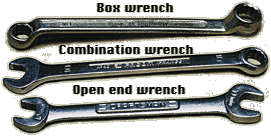
wrenchesBox wrenches, which have a complete loop that surrounds the fastener. They are substantially stronger than open-end wrenches, and are the best to use for high torque applications, both because the wrench is stronger, and because it can contact more than two corners of the fastener.
Combination wrenches are double-ended wrenches with an open end and a box end, usually for the same size on each end. This is the most useful and most common general-purpose wrench style.
Open-end Wrenches have ends shaped like a two-tined fork. They normally have two parallel surfaces which bear against two of the sides of a fastener. Open-end wrenches are faster to put on to fasteners, and are the only kind that can be used where there is not clearance to slip a box wrench over the end of the fastener.(cone wrenches, headset wrenches, pedal wrenches and spoke wrenches) Bicycle applications often call for special-purpose open-end wrenches:
Cone wrenches and headset wrenches differ from normal open-end wrenches in that they are thinner than usual for a given fastener size. I have an article about Cone Wrenches in my Tool Tips series.
Pedal wrenches are thin open-end wrenches with heavy-duty jaws and extra-long handles.
Spoke wrenches have taller contact areas than most wrenches and have short handles for use in the close quarters between spokes.
Socket Wrenches, similar to box wrenches, surround the fastener. Unlike with box wrenches, the outside of the head of a socket wrench is circular so that it can reach a fastener which is recessed into a small hole. A socket wrench may have an offset handle, as with a peanut-butter wrench, but more often, the handle will attach to one end of the socket. Most socket wrenches are part of modular systems, and have interchangeable handles available, including ratchet handles, torque-wrench handles, extensions, breaker bars, and screwdriver-type handles; also extensions, to insert the socket deep into a mechanism, and universal joints, to use when the socket can not be at a right angle to the handle. Extensions and universal joints are not commonly needed for bicycle work.
6 Point vs 12 Point: Socket and box wrenches for hex fasteners come in two types, 6 point and 12 point.
12 point is good for box wrenches, because it gives you twice as many possible orientations to put the wrench on the fastener. This is especially good for working in close quarters, but is rarely an issue on bicycles. 6-point wrenches are stronger and less likely to slip. Generally, 6 points are preferable for bicycle work when you have a crankbolt wrenchchoice.
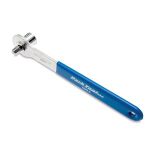
A crank bolt wrench is a special socket wrench used to tighten and loosen the bolts or nuts which attach square-tapered cranks to axles. A crank bolt wrench may also include an Allen wrench, as some crank bolts use one. Some older cranks use different sizes: see my article on cotterless cranks.
Nutdrivers are smaller-sized socket wrenches with screwdriver-type handles. These are often faster to use than conventional wrenches, and the screwdriver-type handle makes it unlikely that you'll strip the threads of a smaller nut or bolt. 8 mm, 9 mm and 10 mm nutdrivers are among my favorite bike tools. They usually have a hollow handle so they can even be used to run a nut down a long bolt. I have an article about Nutdrivers in my Tool Tips series.
Y wrenches are socket wrenches shaped like a Y with a socket on the end of each arm. The common Y wrench for bicycle use has 8, 9 and 10 mm sockets to fit the nuts and bolts used on many brakes and derailers. It is a useful tool to carry for on-road repairs.
Spanner wrenches use pins to engage holes or notches in the fastener.
Pin spanners usually use two pins which fit into a pair of holes in the surface of a fastener. Common bicycle applications for pin spanners include adjustable bottom-bracketcups and freewheelbearingcones. Some crank dust caps and headsetlock nuts also use pin spanners.
Hook spanners have an end shaped a bit like a capital "G". They wrap around a round fastener and the tail of the "G" fits into one of several notches on the fastener. Hook spanners are commonly used on bottom-bracketlockrings and track hub lockrings. They are also used on some headsets.
Allen Wrenches are hexagonal wrenches that fit into matching hexagonal holes. Only a few metric sizes of Allen wrenches are commonly used on bicycles. Many modern bicycles use only Allen-wrench fittings, reducing the weight of a bicyclist's tool kit substantially.
FR-1Spline Wrenches (including Torx, freewheel, etc.) have protruding splines on the inside or outside. Spline wrenches used on bicycles are mostly special wrenches which fit only one particular type or brand of bicycle parts. Many, including the one shown, need to use another wrench as a handle.
Adjustable Wrenches can be adjusted to fit different sized fasteners, usually by the use of a thumbscrew. They don't fit as well as the correct size fixed wrench, so good, well equipped mechanics only use them as a last resort. I have an article about Adjustable Wrenches in my Tool Tips series.
Crescent ® Type Wrenches. Although "Crescent" is a trademark, it is commonly used in the U.S. to refer to a normal, angled head adjustable wrench regardless of brand. The jaws are set at a 30 degree angle to the handle to allow them to be used in tight quarters. They still are much bulkier than box wrenches or open-end wrenches.
Monkey Wrenches have their jaws perpendicular to the handle. They commonly open up much wider than crescent-type wrenches.
Pipe Wrenches are similar to monkey wrenches, except that they have serrated jaws, which are designed with a bit of play which causes them to grip more tightly when turned in the appropriate direction. Pipe wrenches are primarily used for plumbing, and generally have no bicycle application.
Adjustable pin spanners fit a range of different pin spacings. The spring-loaded Park SPA-1 (green) adjustable pin wrench is the most useful one for most adjustable bottom-bracket cups.
Wrenches are sometimes confused with pliers, and naive users sometimes try to use pliers for jobs that really require a wrench, usually resulting in damage to the nut or bolt so abused. It can also cause failure due to undertightening the part involved.