Freewheel or Cassette?



Original article: https://www.sheldonbrown.com/free-k7.html on sheldonbrown.com
- Reproduced with the permission of John Allen and Harriet Fell — all rights reserved. The version on sheldonbrown.com is authoritative.
- Mirrored: 2026-10-04 · Last update of the original: see original
Freewheels and Cassette Freehubs
Freewheels · Cassette Freehubs
They're NOT the same!
This particular page is intended to help you determine which type your bike is equipped with, because there is a great deal of confusion about which is which. The terms "freewheel" and "cassette" are often used interchangeably, an error that causes a lot of wasted time and money.
Freewheels for Threaded Hubs:
Traditional rear hubs came with a standardized set of threads to which a standard freewheel/sprocket cluster could be screwed on. This allowed any brand of freewheel to be mounted on any brand of hub. If you wore out your sprockets, or wanted different gear ratios, you could unscrew the cluster and install a new one. Almost all bikes made through the late 1980s used this system.
Over the last few years the Shimano "Freehub" has largely replaced the conventional threaded rear hub. It is sad to lose the brand interchangeability that formerly existed, but these hubs work so well that they have come to represent the new "standard." Most decent-quality bikes made since the late 1980s have used this greatly improved design.


| Traditional Threaded Freewheel |
Traditional Threaded Hub |
Cassette Freehub | Cassette Cluster |
The cassette Freehub incorporates the ratchet mechanism into the hub body (although the ratchet mechanism is still replaceable). When you wear out the sprockets on a Freehub, you replace the sprockets only, not the ratchet mechanism (which typically lasts much longer than the sprockets).
The sprockets are commonly sold as a set, called a "cassette". The sprockets in a cassette are usually held together by three small bolts or rivets for ease of installation. These bolts or rivets are by no means necessary, they just make it easier to keep the sprockets and spacers in the correct order and position when they are removed from the ratchet body. Individual sprockets are also available.
The purpose of this page is to help you distinguish one type from the other.
This site also contains much more detailed articles on both Freewheels and Cassettes, explaining the pros and cons of each system.
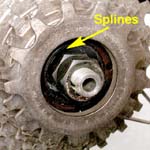
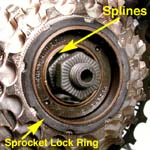
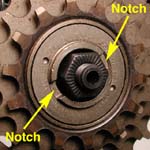
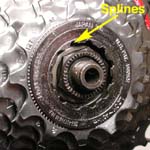
Identification: Freewheel or Cassette?
|
|
|
|
|---|---|---|---|
| Sachs (Sram) Freewheel | Shimano Hyperglide Freewheel | Sun Tour Two-notch Freewheel | Cassette with Lockring |
(Click for details)
|
|

Shimano Cassette Freehub, showing characteristic bulge on the right side of the body.
Not all Freehubs have this bulge, but whenever you see it, you can be sure that it is, in fact, a cassette Freehub.